


A “water-resistant” label alone won’t tell you whether leggings are ready for a swim. Water-resistant leggings for beach activities can sound like the obvious choice, but the wording doesn’t explain how a garment performs in the water, how quickly it dries, or what sun protection it provides.
It makes sense to want one comfortable layer for shoreline walks, paddleboarding, and time in the surf. Choose according to your activity and the garment’s stated features, not the label alone. Regular workout leggings and swim leggings aren’t automatically interchangeable, especially if you plan to get in the water.
In this guide, we’ll explain what water-resistant, quick-drying, and UPF claims mean, then show you what to compare for comfort, movement, and coverage. You’ll also learn how built-in UPF 50+ protection and quick-drying performance can support a beach day. Ocean Motion Wear swim leggings are made with recycled polyester-based fabric and designed for movement in and out of the water. Use the features that matter to you to choose gear for your plans.
Key Takeaways
- Judge water-resistant leggings for beach activities by documented garment features and your plans, not the label alone.
- Compare swim and gym leggings by intended activity, fabric information, and the coverage you prefer.
- Start with your activity, then weigh coverage, freedom of movement, sun protection, and drying needs.
- Ocean Motion Wear swim leggings use recycled polyester-based fabric and combine built-in UPF 50+ protection with quick-drying performance.
What “Water-Resistant Leggings” Means for Beach Activities
Can leggings work for a day at the beach? They can suit some beach plans, depending on what the garment is designed to do and how you’ll use it. Water-resistant leggings for beach activities aren’t automatically swimwear, and a label by itself doesn’t tell you how a pair will perform during a swim, snorkel, or paddle.
Use the wording as a clue, not a guarantee. “Water-resistant” suggests that a fabric or finish may slow water penetration or shed some moisture, but the term alone doesn’t establish how much water it can handle. “Waterproof” describes a stronger barrier intended to prevent water from passing through, though construction and conditions matter. The Waterproof fabric overview explains how these terms relate to different fabric types and applications. For a garment, rely on its explicit specifications rather than assuming a label proves a particular level of protection.
Water-resistant, waterproof, and quick-drying are not interchangeable
Quick-drying describes how readily a fabric dries after getting wet. It doesn’t mean water stays out. A quick-drying garment may still become wet during swimming; the feature describes drying performance, not waterproof construction. Likewise, “water-resistant” doesn’t establish whether an item is intended for swimming or only for brief exposure to splashes.
Look for concrete details such as stated quick-drying performance, fabric composition, and the activities the garment is designed for. If a description uses only a broad label, don’t fill in the gaps with assumptions. These distinctions help set realistic expectations before you head to the shore.
Why people choose leggings for a beach day
Leggings offer a familiar option if you prefer more leg coverage, want clothing that moves with you, or feel more comfortable in a close-fitting layer. Those preferences can matter throughout a beach day, but each setting asks something different of your clothing.
- Swimming: Check whether the garment is described for use in water and whether its fit feels comfortable while moving.
- Snorkeling: Consider how much coverage you want and whether the fabric and design suit time spent moving through the water.
- Paddleboarding: Prioritize comfortable movement and the coverage you want while getting on and off the board.
- Time on the sand: Consider whether the leggings feel comfortable for relaxing or walking, as well as for any planned water activity.
Comfort is personal. A pair that feels right for a shoreline walk may not be your preferred choice for swimming. Match the garment to the activity, check its stated features, and choose coverage that lets you move comfortably. Don’t assume leggings provide warmth or replace specialized equipment. The right choice begins with what you plan to do, not just the words on a product label.
How Beach Leggings Handle Sun Coverage, Movement, and Drying
Beach leggings can provide more than a layer of coverage, but each feature answers a different question. A UPF rating describes the garment’s sun-protection performance. Stretch relates to how fabric moves with you. Quick-drying and breathable describe comfort and drying characteristics, not a barrier that keeps water out. Read these details separately to see how they fit your plans.
Ocean Motion Wear swim leggings have built-in UPF 50+ protection and lightweight, breathable, quick-drying fabric. They’re designed for movement in and out of the water. These details offer a clearer basis for comparison than the phrase “water-resistant” alone.
What UPF 50+ adds to beach clothing
UPF, or Ultraviolet Protection Factor, is a rating for how well clothing helps limit ultraviolet radiation reaching covered skin. Ocean Motion Wear’s built-in UPF 50+ protection blocks over 99% of UVA and UVB rays. The rating applies to the garment, not the skin left uncovered. Plan separate protection for areas such as your face, hands, and any skin not covered by clothing.
Consider coverage as well as the rating. Leggings cover the legs, while other parts of the body may remain exposed depending on what you wear. UPF clothing can be a useful part of your beach sun-protection plan, but it doesn’t cover exposed skin. Match your clothing coverage to your plans and account for the areas the garment can’t cover.
Why stretch and quick-drying fabric matter in motion
Comfort can change once you start moving. If a product’s specifications explicitly state four-way stretch, that tells you the fabric is designed to stretch across multiple directions, which may help it move with your body. Don’t assume this feature from a general “performance” label; look for the specific wording. Ocean Motion Wear’s swim-legging details don’t state four-way stretch, so treat it as unconfirmed rather than an established feature.
Quick-drying means the fabric is described as drying readily after it gets wet. It doesn’t promise a set drying time or mean the garment stays dry during a swim. Breathable and lightweight are also useful stated features to consider for comfort across changing beach activities, without treating them as guarantees of how a garment will feel in every condition.
- Sun coverage: Check the stated UPF rating and consider which areas remain uncovered.
- Movement: Look for explicit stretch information if flexibility is a priority for your activity.
- Drying: Treat “quick-drying” as a fabric feature, not a promise about a specific time.
- Comfort: Consider whether lightweight, breathable fabric suits the way you plan to wear the leggings.
Assess water-resistant leggings for beach activities through specific garment details, not by combining unrelated claims into one assumption. UPF, stretch, breathability, and drying performance each describe something different. Compare them with your intended use and choose the combination that supports your coverage preferences and movement on the shore or in the water.
Swim Leggings vs. Gym Leggings: Compare Them by Beach Activity
A category name is a starting point, not proof of performance. Swim leggings are intended as swimwear, while gym leggings are generally sold as activewear, but the features of individual garments vary. For beach use, compare the product’s stated fabric details and activity guidance with what you plan to do. Evaluate water-resistant leggings for beach activities by their documented features, not assumptions about a label.
Use this comparison to decide what to check. It isn’t a claim that every pair in either category has the same construction or capabilities.
| Intended activity | Swim leggings: stated features to look for | Gym leggings: stated features to look for | Coverage preference |
|---|---|---|---|
| Swimming or snorkeling | Look for swimwear purpose, fabric details, and any stated UPF or quick-drying features. | Check whether the product description explicitly addresses water use, drying, or sun protection. | Choose the leg coverage and fit that feel comfortable in the water. |
| Paddleboarding | Review activity guidance, fabric details, and stated movement or sun-protection features. | Look for clear information about movement, fabric, and intended use rather than relying on “activewear.” | Consider how much coverage you want while moving on and off the board. |
| Walking or relaxing on the sand | Compare comfort, fabric description, and the coverage you want for a beach day. | Consider the garment’s stated comfort, care instructions, and fabric composition. | Personal preference may matter more than whether the label says swim or gym. |
When swim-specific leggings may make more sense
If you expect to swim or spend extended time around the water, swimwear-specific descriptions can make it easier to assess whether a garment suits your plans. Look for concrete features such as stated UPF protection and quick-drying performance. Ocean Motion Wear swim leggings, for example, use recycled polyester-based fabric and have built-in UPF 50+ protection and quick-drying performance. These are specific product details, not a promise that every pair of swim leggings performs alike.
Consider your own comfort and the conditions you expect. No single fabric description establishes suitability for every water temperature or activity, and leggings shouldn’t be assumed to replace specialist gear.
When existing gym leggings may meet your needs
For a beach walk or time on the sand, leggings you already own may suit your comfort preferences. Before taking them into the water, read the fabric composition and care instructions. A gym label alone doesn’t confirm water-specific use, quick-drying performance, or a UPF rating. Look for each feature in the garment’s specifications.
Match the evidence to the activity: a swim calls for different considerations than a stroll along the shore. Then weigh comfort and coverage against what the product clearly states. That comparison keeps the category name in perspective and helps you choose with confidence.
How to Choose Leggings for Swimming, Snorkeling, and Paddleboarding
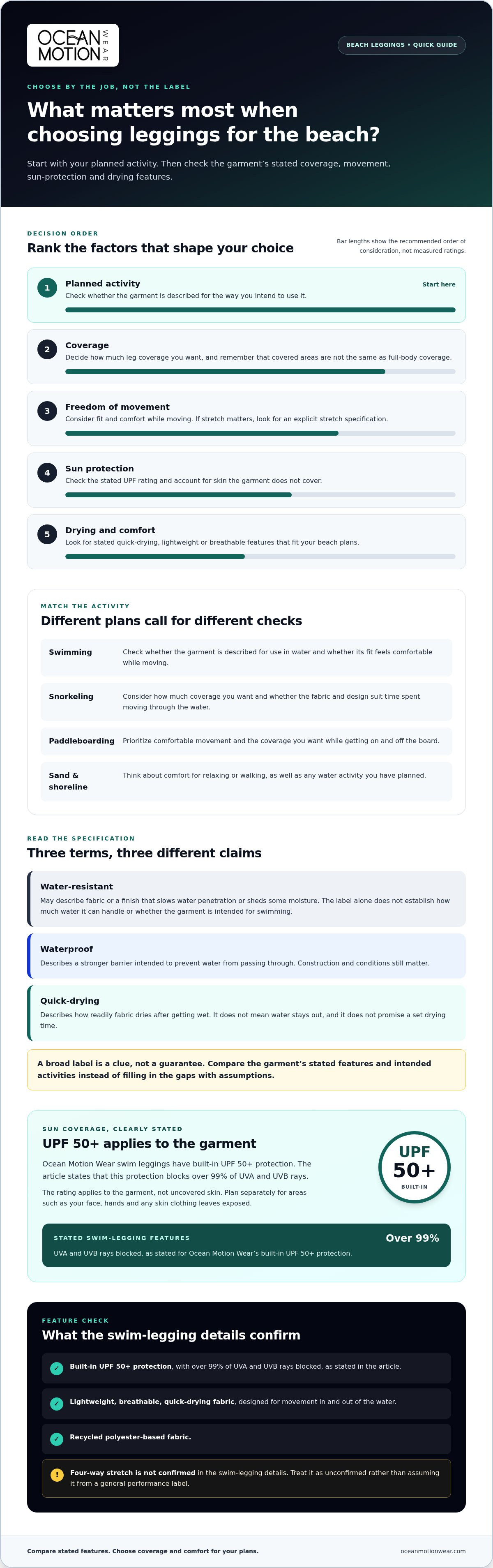
Start with your plans, not a product label. A pair that feels comfortable for a beach walk may not be the one you want for swimming or time on a board. Use this process to compare the features that matter for your activity, then decide whether the coverage and fit feel right for you.
- Decide where and how you’ll wear them. Are you swimming, snorkeling, paddleboarding, or moving between the water and the sand? Be specific. The more time you expect to spend in the water, the more useful it is to prioritize swimwear purpose and clearly stated fabric information over a general activewear label.
- Choose your coverage preference. Consider how much of your legs you want covered and whether that feels comfortable for the activity. For snorkeling, also think about sun exposure during your time outdoors. Clothing coverage can be part of your sun plan, but it doesn’t protect skin the garment leaves uncovered.
- Consider movement and fit. For swimming, look for product details describing use in and out of water. For paddleboarding, think about the range of movement you want while getting on and off the board. Fit and comfort are personal; choose according to how you prefer clothing to feel and move, rather than assuming a particular cut will suit everyone.
- Read the specifications and care details. Look for stated fabric composition, UPF rating, stretch information, and care instructions. Don’t infer a feature from “performance,” “gym,” or “water-resistant” wording alone. If four-way stretch matters to you, for example, look for that claim explicitly in the product information.
Match coverage and movement to the activity
For swimming, give weight to details that describe the garment’s intended use and performance, such as stated quick-drying features. For snorkeling, consider both freedom of movement and sun coverage, while remembering that leggings don’t promise protection from hazards in the water. Paddleboarding calls for a comfortable fit and coverage you’re happy to wear while moving on the board. Don’t assume a garment has grip or abrasion-resistant features unless its specifications say so.
Check product information and plan ahead
Ocean Motion Wear swim leggings use recycled polyester-based fabric and feature built-in UPF 50+ protection and quick-drying performance. Their designs are intended for movement in and out of water. We make items to order as part of our approach to reducing overproduction, so factor the timing information provided during the buying process into plans for a fixed date. For similar movement-focused time on the water, kayaking clothing can offer another comparison point as you consider coverage and fabric details.
Once you know what matters for your plans, explore ocean-inspired swimwear and apparel with those priorities in mind.
Ocean Motion Wear Swim Leggings: Confirmed Features for Beach Days
Ocean Motion Wear creates ocean-inspired swimwear and apparel for divers, swimmers, and beachgoers. Our swim leggings bring together a focused set of features for time around the water: recycled polyester-based fabric, built-in UPF 50+ protection, and quick-drying performance. They’re designed for movement in and out of the water, offering a considered option if you want leg coverage as part of your beach-day clothing.
Clear details matter more than a broad label. The phrase “water-resistant leggings for beach activities” can be a useful search starting point, but it shouldn’t be mistaken for a description of our leggings. We describe their specific features so you can compare them with your plans and comfort preferences.
Which confirmed features connect to beach activities?
Built-in UPF 50+ protection blocks over 99% of UVA and UVB rays on covered areas. It doesn’t protect skin the leggings leave exposed, so plan separately for uncovered areas. Recycled polyester-based fabric and quick-drying performance are also confirmed features. Quick-drying describes how the fabric performs after it gets wet, not a set drying time or a promise that water won’t reach the garment.
The designs are intended for movement in and out of water. These features are relevant to beachwear decisions without promising suitability for every condition or activity. Consider each detail in relation to how you plan to wear the leggings.
Ocean-inspired design with a considered production approach
Ocean-inspired design reflects the environments that shape our swimwear and apparel. Material choice is part of that approach: all items use recycled polyester-based fabrics. We also make items to order as part of an effort to reduce overproduction. These are purposeful choices, not a claim of zero environmental impact or a substitute for evaluating the features you need.
If sustainability is part of your decision, consider both what a garment is made from and how its production approach aligns with your priorities. Then weigh those choices alongside practical details such as UPF protection, quick-drying performance, and coverage. The right balance is personal, and clear product information helps you make an informed choice.
Our swim leggings offer a combination of confirmed features and ocean-inspired design. Use the details to decide whether they fit your beach plans, and explore ocean-inspired swimwear and apparel to see more of what we make.
Ocean Motion Wear Swim Leggings: Confirmed Features for Beach Days
Ocean Motion Wear is an ocean-inspired brand for divers, swimmers, and beachgoers. Our swim leggings bring together three clearly described features: recycled polyester-based fabric, built-in UPF 50+ protection, and quick-drying performance. They’re designed for movement in and out of water, giving you practical details to weigh against your beach plans.
The phrase “water-resistant leggings for beach activities” can help describe what you’re searching for, but it doesn’t describe our leggings. We focus on features we can state clearly, so you can make a decision based on garment information rather than assumptions about a label.
Which confirmed features connect to beach activities?
Built-in UPF 50+ protection blocks over 99% of UVA and UVB rays on covered areas. It doesn’t protect skin the leggings leave exposed, so include uncovered areas in your sun-protection plan. Consider both the rating and the garment’s coverage when deciding how the leggings fit into your beach clothing.
Our swim leggings use recycled polyester-based fabric and have quick-drying performance. Quick-drying describes how the fabric performs after getting wet. It isn’t a set drying-time promise, and it doesn’t mean water stays out. The leggings are also designed for movement in and out of water, which may be relevant if your plans shift between the shore and the water. Choose based on these stated qualities and the way you expect to wear them.
Ocean-inspired design with a considered production approach
Ocean-inspired artwork brings the natural world into our swimwear and apparel. The design perspective is paired with material choices: all items are made from recycled polyester-based fabrics. These details can help you consider both how a garment is made and what it offers for beach wear, without treating a material choice as proof of a particular environmental outcome.
We also make items to order as part of our approach to reducing overproduction. It’s one considered production choice, not a claim that a garment has no impact. If you’re weighing material and production choices alongside practical features, use a sustainable swimwear guide to think through what matters most to you, then compare those priorities with the product details.
For a clear comparison, keep the features distinct: UPF 50+ protection applies to covered areas, quick-drying describes drying performance, recycled polyester-based fabric identifies the material, and movement in and out of water describes the design intention. Together, they offer a grounded picture of our swim leggings without overstating what they can do. Use those facts to decide whether they align with your preferred coverage and plans for a day by the coast.
Choose With Your Next Beach Day in Mind
Let the activity guide your choice. Picture the day ahead, the movement it involves, and the coverage that will help you feel comfortable. Then use product descriptions to confirm the details that matter instead of relying on a broad label to set expectations. That habit makes it easier to find leggings that fit your plans, whether you’re heading for a swim or staying close to shore.
Keep “Water-resistant leggings for beach activities” in perspective as you browse. The phrase can start your search, but your decision should come down to clearly stated features and your own preferences. Choose thoughtfully, and you’ll be better prepared to enjoy the coast on your terms.
Ready to find a style that suits your next outing? Explore Ocean Motion Wear’s ocean-inspired collection and discover apparel for your time by the water.
Make your choice with confidence, then step into your next beach day feeling prepared to move, explore, and enjoy the moment.
Frequently Asked Questions
Are water-resistant leggings waterproof?
No. “Water-resistant” and “waterproof” aren’t interchangeable, and neither label alone tells you exactly how a garment will perform in the water. For water-resistant leggings for beach activities, read the specific product details and look for features relevant to your plans. Ocean Motion Wear describes its swim leggings as quick-drying and designed for movement in and out of water. Use stated features, not assumptions, to guide your choice.
Can I wear regular gym leggings in the ocean?
Possibly, depending on the garment and what feels comfortable to you. Before wearing gym leggings in the ocean, check their fabric composition and care information, and look for explicit details about water use or UPF protection. A gym or activewear label doesn’t establish either feature. If you’ll be swimming rather than walking along the beach, swim-specific leggings may make it easier to compare the information that matters for your plans.
Do UPF 50+ leggings replace sunscreen?
No. UPF clothing covers only the skin beneath it, so plan separately for exposed areas such as your face, hands, and neck. Ocean Motion Wear states that its built-in UPF 50+ protection blocks over 99% of UVA and UVB rays on covered areas. For a long beach day, think through your full outfit and sun-protection routine before heading out, and follow the directions on any sunscreen you use.
Can I wear swim leggings for paddleboarding?
Yes, swim leggings can be an option for paddleboarding if their fit, coverage, and stated features suit your preferences. Consider how you want the fabric to feel as you move on and off the board, and review the garment’s product information before deciding. Ocean Motion Wear designs its items for movement in and out of water. Don’t assume leggings provide grip, flotation, or abrasion protection unless those features are specifically stated.
How should I care for leggings after swimming in the ocean?
Follow the care instructions provided for that specific garment. Fabric blends and construction can vary, so instructions for one pair may not apply to another. Don’t assume a garment resists saltwater or chlorine unless its product details say so. If you can’t find care directions, avoid borrowing a washing method from a different item. The garment’s own care guidance should take priority over general advice.
Are swim leggings warm enough to replace a wetsuit?
No. Don’t assume leggings provide the insulation of a wetsuit. Swim leggings are apparel for coverage and movement, while warmth depends on the garment’s construction and the conditions you’ll encounter. Ocean Motion Wear doesn’t state a temperature rating or describe its swim leggings as a wetsuit replacement. Consider the water and weather conditions for your activity, and choose appropriate exposure protection rather than relying on leggings for warmth.
