


Sharks don't care if your dive kit is fluorescent yellow, bright pink, or solid black. For decades, ocean lovers have traded nervous warnings about the myth of "yum yum yellow," convinced that wearing the wrong shade turns you into an accidental target. When divers and swimmers ask, do sharks see color, they are usually trying to quiet a very real anxiety about safety during ocean encounters. That hesitation makes total sense. Nobody wants to drop into deep water wondering if their gear looks like a flashing beacon to an apex predator.
I'll break down the latest research on shark vision and explain why contrast matters more than color when you're choosing your next dive gear. We will look at how sharks actually process light, why edge silhouettes trigger predatory curiosity, and how understanding marine biology helps you select gear that moves in quiet harmony with the ocean.
Key Takeaways
- When divers ask do sharks see color, visual neurobiology reveals that most species are cone monochromats who navigate an aquatic world rendered in shades of gray.
- Discover why luminance contrast and sharp edge silhouettes grab an apex predator's attention far more than any individual hue.
- Learn the true origin of the "yum yum yellow" myth and why vintage search-and-rescue gear gave divers the wrong impression.
- Master the balance between critical surface visibility for boat traffic and low-contrast apparel choices while down below.
- Explore how disruptive, nature-inspired patterns break up your visual outline along reefs from Kona to Kauai.
The Short Answer: Are Sharks Colorblind?
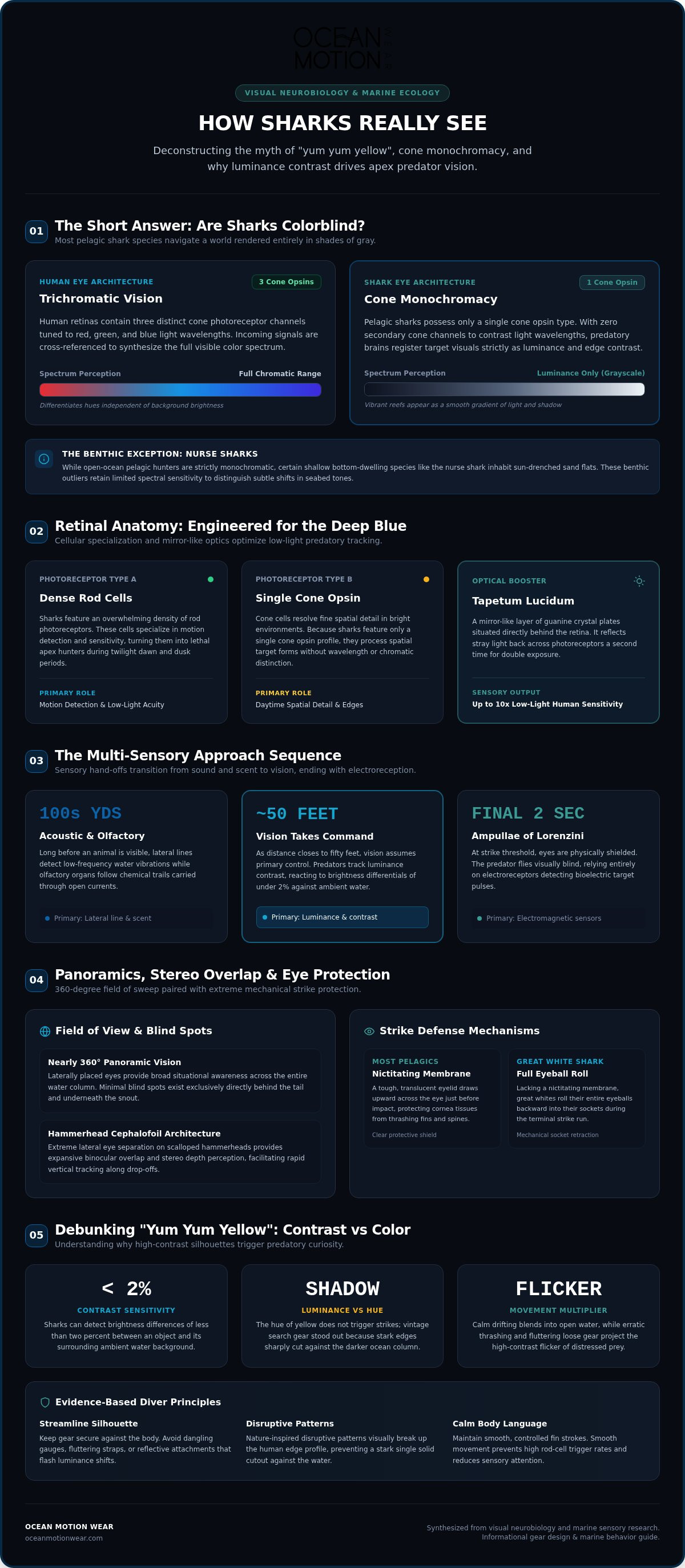
I've spent years watching reef sharks glide past me along the drop-offs in Kona, always wondering what they saw as they rolled a dark eye toward my fins. The short answer from visual neurobiologists is clear: most sharks are completely colorblind. When divers ask do sharks see color, the science points directly to the sensory wiring in their retinas. Monochromatic vision is the ability to see only one color channel. While human eyes carry three distinct types of cone photoreceptors to distinguish between red, green, and blue wavelengths, sharks lack the neural hardware needed to separate hues. To an apex predator, the vibrant blues and corals of the reef appear as a smooth gradient of light and shadow.
Rods vs. Cones in the Deep Blue
Retinal anatomy explains why this visual system evolved so effectively. Marine eyes divide labor between two primary cell types:
- Rod cells: Highly sensitive photoreceptors specialized for motion detection and low-light acuity. Sharks possess an overwhelming density of rods, making them lethal hunters during the twilight windows of dawn and dusk.
- Cone cells: Daytime photoreceptors responsible for fine spatial detail and chromatic vision.
Sharks typically have only a single cone opsin type in their retinas. Without a second or third cone channel to cross-reference incoming light wavelengths, their brains register visual targets strictly through luminance rather than hue.
Exceptions to the Colorblind Rule
Nature loves an outlier, and marine visual systems are no different. A few bottom-dwelling species, such as the nurse shark, live in shallow, sun-drenched flats where distinguishing subtle shifts in seabed tones provides a hunting advantage. These benthic species may retain limited spectral sensitivity compared to their open-ocean cousins.
Yet for nearly all pelagic hunters, brightness contrast trumps color entirely. Their sight is boosted by the tapetum lucidum, a mirror-like layer of guanine crystal plates sitting directly behind the retina. This natural reflector bounces stray light back across the photoreceptors a second time, giving sharks up to ten times the low-light sensitivity of human eyes. They might miss the exact color of your suit, but they instantly map your outline against the water column.
Anatomy of the Hunt: How Shark Eyes Actually Work
A hunting shark is a masterclass in sensory layering. Long before an animal comes into view, acoustic sensors and the lateral line system detect low-frequency vibrations from hundreds of yards away. Olfactory organs register dissolved chemical trails across open currents. Yet as the distance closes to roughly 50 feet, vision takes over as the primary guiding system for the final approach.
Most pelagic species feature laterally placed eyes, providing an expansive, nearly 360-degree panoramic view of the marine environment. There are slight blind spots directly behind the tail and beneath the snout, but little escapes their sweep. I have spent time diving alongside scalloped hammerheads, watching how their wide cephalofoil positions their eyes on extreme opposite sides. That separation gives them exceptional binocular overlap and stereo depth perception, letting them track rapid vertical movements along drop-offs.
The Power of Contrast and Movement
Because these predators do not process chromatic hues, their visual processing centers prioritize luminance contrast. Ryan and fellow researchers found that sharks detect brightness differences of less than 2% between an object and its ambient background. A solid silhouette cutting against downwelling sunlight triggers an immediate response, while erratic movement amplifies that visual signal. If you are drifting calmly, you blend into the water column. Thrash your limbs or let loose gear flutter in the current, and you instantly project the rapid flicker of distressed prey.
The Nictitating Membrane: Built-in Eye Protection
Close inspection of a hunting shark reveals a tough, translucent barrier called the nictitating membrane. Think of it as a clear eyelid that draws upward across the eye just before a strike. I have watched this engage during rapid feeding sequences, shielding the delicate cornea from thrashing fins and sharp fish spines. Great whites lack this membrane and roll their entire eyeballs backward into their sockets instead.
This barrier means that for the final two seconds of an attack run, the shark is essentially flying blind. It relies entirely on ampullae of Lorenzini to sense electromagnetic pulses from its target. Understanding this sequence proves why asking do sharks see color is only part of the equation. Staying safe around them is never about hiding from an imaginary color spectrum. It comes down to staying calm, keeping your silhouette streamlined, and wearing ocean apparel that prevents high-contrast flashing in the water.
The Myth of 'Yum Yum Yellow' and High-Contrast Gear
The infamous phrase "yum yum yellow" traces back to military testing in the 1970s. Search-and-rescue teams chose fluorescent yellow for life vests and life rafts specifically to help human pilots spot floating survivors against deep ocean swells. During water trials, curious sharks nudged yellow test dummies far more often than dark ones, creating a stubborn maritime rumor that sharks find yellow appetizing. In reality, yellow is not a tasty hue to a predator. Luminance contrast against dark open water is far more influential to a shark than the specific hue of yellow.
Sharks investigate high-contrast targets because sudden brightness spikes often mirror injured prey. Flashing silver scales from a wounded baitfish produce rapid shifts in reflectance, grabbing a predator's attention across the reef.
Why Bright Colors Look Different Underwater
Water acts as a dense liquid filter, stripping away light wavelengths one by one. Red wavelengths vanish within the first 15 to 20 feet of the surface. By the time you drop below 30 feet, ambient light shifts entirely to blue and green tones. This optical fact settles the question of whether do sharks see color in practical diving conditions. Even if a shark had human-like eyes, most warm hues cease to exist down there. Fluorescent pigments, however, convert invisible ultraviolet light into visible wavelengths, holding their stark brightness at depth. That persistence creates an intense silhouette that catches a shark's eye from yards away.
Patterns That Mimic or Camouflage
Solid blocks of color present an unbroken edge profile, making you instantly recognizable as a distinct shape in the water column. Pelagic predators avoid this vulnerability through countershading: dark slate coloring along the back blends into deep drop-offs below, while pale bellies dissolve against bright sunlit ripples above. Disruptive patterns work in the exact same manner by breaking up hard outlines into soft, irregular shapes.
We lean into these exact principles across our gear design. Instead of relying on jarring, solid blocks of high-visibility tones, our Whale Shark collection borrows the natural dappled camouflage of the ocean's gentle giants. These organic white-and-slate patterns scatter light across your shoulders and legs, helping you move seamlessly through the water column without projecting harsh, isolated borders.
Choosing Your Dive Gear: Visibility, Contrast, and Safety
Early in my diving days, I thought wearing solid black from head to toe was the safest bet around predators. I learned the hard way that looking like a dark, solid silhouette against open water mimics pinnipeds far too closely. At the same time, going fully invisible underwater creates practical hazards with your own dive team. You need enough visual presence for your buddy to spot you at thirty feet, without presenting the harsh outlines that trigger predatory curiosity. Once you understand that asking do sharks see color leads to luminance rather than pigment, balancing buddy awareness and wildlife etiquette becomes straightforward.
Eliminating micro-contrasts on your body makes an immediate difference. Exposed pale ankles against dark booties or loose strands of hair fluttering in the current can mimic the erratic twitches of a wounded reef fish. That is why I always wear a dive headband to lock stray hair in place before splashing in. Similarly, slipping into full-coverage swim leggings eliminates stark skin-to-gear boundaries while providing a streamlined profile in the current.
The Case for Patterned Rash Guards
Disruptive ocean prints solve the silhouette dilemma cleanly. Rather than presenting a solid wall of dark fabric, an organic pattern breaks your edges into fragmented shapes that blend naturally with ambient reef shadows. I reach for my UPF 50+ performance rash guard on every Hawaii boat day because it handles two jobs at once. It eliminates surface glare and skin contrast beneath the surface, while shielding my back during long surface intervals under tropical sun. Sliding into water feeling calm, protected, and stealthy changes your entire mindset during an encounter.
Safety Protocols During Shark Encounters
Gear selection sets the foundation, but underwater composure governs how animals react to you:
- Stay submerged and keep fins down: According to the ISAF 2025 Annual Report, 46% of unprovoked bites involved surface swimmers and waders. Splashing at the air-water boundary produces high acoustic and visual contrast.
- Maintain direct eye contact: Apex predators rely on the element of surprise. Tracking a cruising shark with steady, deliberate head turns signals that you are an aware observer rather than vulnerable prey.
- Secure loose straps: Dangling computer consoles or loose fabric flaps flutter in surge, creating rapid localized movement that invites close inspection.
When you are ready to update your water kit with mindful patterns that keep you secure, explore our complete line of sustainable swimwear and dive apparel.
Wear the Ocean: Why We Use Scientific Inspiration in Our Prints
Every piece of ocean apparel should serve a dual purpose: keep you comfortable during demanding water sessions and honor the marine environment you explore. That philosophy drives how we build our gear. Our prints draw directly from real hours logged on outer reefs, like the caverns at Tunnels on Kauai's North Shore. Rather than applying generic tropical art, we translate natural aquatic textures into performance wear. When you look at how pelagic creatures hide in plain sight, understanding whether do sharks see color becomes an incredible design blueprint.
Mindful performance also means protecting the habitats that inspire us. We craft our gear using recycled materials, relying on made-to-order production cycles that eliminate excess textile waste. For divers who want functional beauty rooted in genuine marine biology, our Whale Shark collection celebrates one of the ocean's most iconic evolutionary patterns.
Art Meets Marine Biology
Evolution spent millions of years perfecting pelagic camouflage. The dappled white spots on a whale shark are as distinct as a human fingerprint, breaking light across the animal's dorsal plane so it blends effortlessly into open current. We mirror that balance in our pieces, creating visual harmony that softens hard silhouettes in the water column.
Our other designs look directly to the seabed. We capture the luminous, shimmering textures of marine mollusks in our Abalone collection, dispersing ambient light across soft tonal gradients. To make sure every ocean enthusiast moves through the surf with absolute confidence, we build these pieces with inclusive sizing that supports every body type.
Supporting the Ocean Community
Healthy oceans depend on informed water lovers who dive with respect and curiosity. We support this community by providing technical UPF 50+ fabrics that protect your skin without shedding harmful chemical sunscreens onto fragile living coral. Every rash guard, legging, and swim accessory is constructed to hold up against salt, sun, and repeated tank strap friction.
We love partnering with local operators, scientific research teams, and guiding crews who share our passion for conservation. If you are an outfitter looking to outfit your dive staff with mindful, durable ocean wear, explore our wholesale options to collaborate with us.
Dive Smarter: Move With the Rhythm of the Reef
Understanding the science behind the question, do sharks see color, strips away decades of unnecessary anxiety. Apex predators navigate by luminance contrast, water displacement, and edge silhouettes rather than picking apart specific dyes. When you select gear that softens sharp body outlines and eliminates accidental flutter, you drop into the water column as a calm, respectful observer rather than an erratic anomaly.
True ocean confidence comes from preparation and knowledge. We build gear designed by divers for divers, marrying technical utility with a mindful approach to marine life. Crafted from recycled materials and featuring built-in UPF 50+ sun protection, every piece stands up to long boat crossings and demanding surface intervals. You don't need to fear the water when you understand how its creatures see you. Explore the Whale Shark collection and sustainable ocean gear, and take your next stride into the blue with total peace of mind.
Frequently Asked Questions
Can sharks see the color red underwater?
No, sharks cannot see red, and underwater physics makes it invisible to almost everything else too. Water absorbs red light within the top 15 to 20 feet of the surface. Because sharks possess monochromatic vision with a single cone type, they process red objects as dull shades of dark gray or black. To a shark, a red suit simply blends into deeper water as a muted silhouette.
Are sharks attracted to bright colors like pink or orange?
Sharks are not attracted to pink or orange as pigments, but they do notice high contrast. When divers ask do sharks see color, the key factor is always how an object reflects light against the background. Bright neon tones pop against dark pelagic water, creating a stark visual border. A shark investigates that boundary out of sheer curiosity, not because it likes the hue.
Is it true that sharks are attracted to blood from a mile away?
No, the idea that sharks smell a single drop of human blood from miles away is purely Hollywood fiction. Sharks have an acute sense of smell, detecting amino acids at roughly one part per million, but scent molecules must physically drift through ocean currents to reach their nares. In open water, this process takes significant time, and human blood does not trigger the predatory feeding frenzy that oily fish blood does.
Should I avoid wearing shiny jewelry while diving with sharks?
Yes, you should always leave watches, necklaces, and metallic clips tucked away or off your body entirely. Polished metal catches downwelling sunlight and flashes brightly against open water. To a hunting predator, that quick metallic gleam mimics the reflective sheen of a wounded baitfish's scales. Sticking to matte fabrics and covered gear removes that sudden visual trigger.
Why is yellow often called 'Yum Yum Yellow' in the dive community?
The moniker started during post-WWII military trials testing bright yellow life vests and rafts. Yellow was chosen because it offered maximum visual contrast for airborne human rescue crews searching dark seas. Curious sharks investigated yellow test gear more frequently simply because it created a stark edge silhouette against the deep blue. Divers noticed this trend and coined the catchy, half-joking nickname.
Do different shark species see color differently?
While the vast majority of pelagic species are cone monochromats, subtle differences exist between habitats. Visual neurobiology confirms most open-ocean sharks have only one cone opsin, locking their vision into grayscale. However, certain benthic dwellers like nurse sharks live in bright, shallow flats and may possess limited spectral discrimination. Even so, determining do sharks see color across the board consistently leads to contrast, not shade, as their main visual guide.
What is the best color to wear to avoid shark attention?
Subdued, low-contrast tones like slate, dark blue, or broken patterns are best for minimizing attention underwater. Solid high-visibility suits create stark silhouettes against the water column, while solid black can mimic the outline of marine mammals. We recommend patterned rash guards and swim leggings that blend softly into reef textures, breaking up your edges without making you completely invisible to your dive buddy.
How do sharks use their other senses if their vision is limited?
Sharks rely on a layered network of senses to compensate for monochromatic vision. Their inner ears detect low-frequency thrashing from hundreds of yards out, while their lateral lines track minute pressure shifts in the current. Once within close proximity, electroreceptive ampullae of Lorenzini map the electrical pulses of heartbeats and muscle twitches. Vision simply provides the final targeting lock just before an encounter.
