


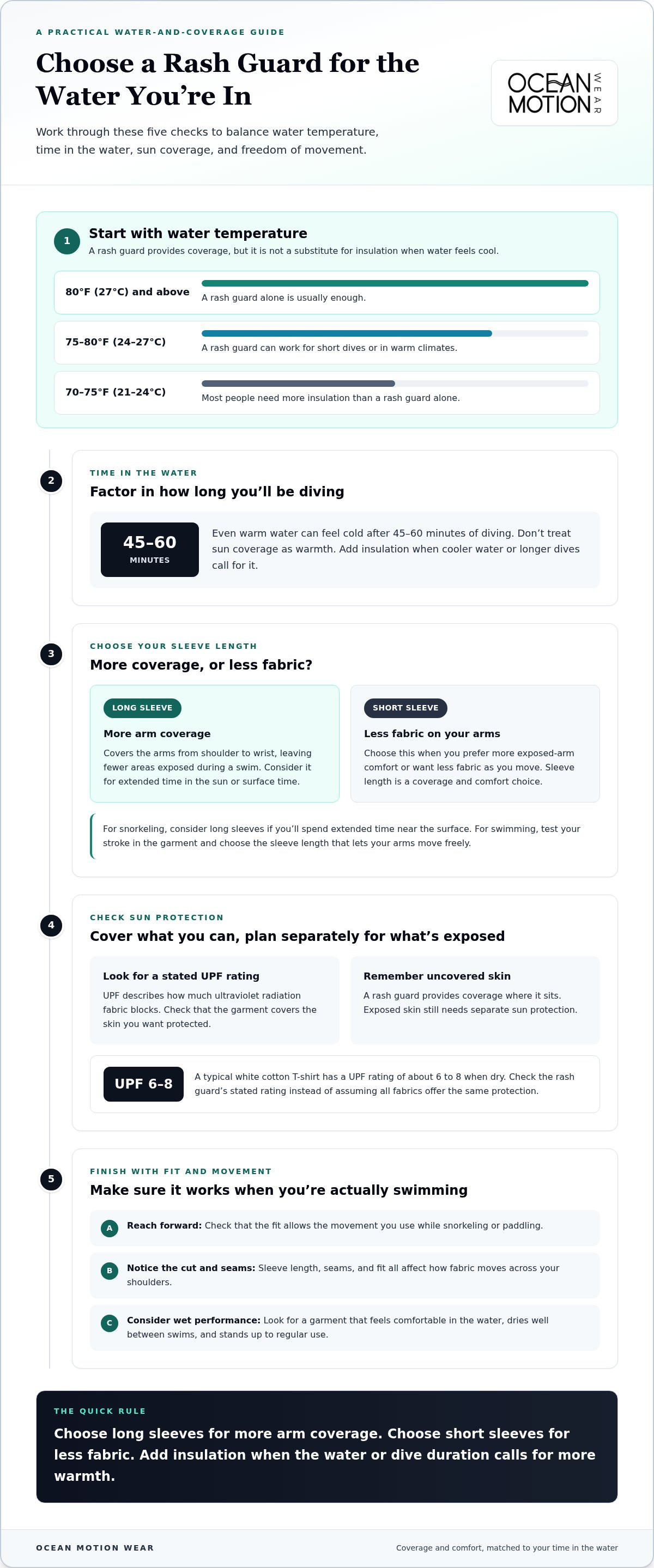
More coverage isn’t always the better choice. Choose a long-sleeve reef-safe rash guard for more skin coverage in the sun, or a short-sleeve style when you prefer less fabric on your arms. For water at 80°F (27°C) and above, a rash guard alone is usually enough; at 75-80°F (24-27°C), it can work for short dives or in warm climates, while at 70-75°F (21-24°C), most people need more insulation.
It’s easy to focus on sleeve length and overlook how a rash guard performs when wet. The right choice should feel comfortable in the water, dry well between swims, and stand up to regular use.
This guide compares sleeve lengths, full-body styles, fabric choices, drying performance, and durability. See how each tradeoff affects sun coverage, movement, and comfort, then choose gear that suits your time in the water.
Key Takeaways
- Choose sleeve length by the coverage and freedom of movement you want, not by appearance alone.
- Compare a two-piece outfit with a full-body dive skin for coverage, comfort, and practical breaks.
- Look beyond fabric feel: material composition affects how a rash guard behaves when wet and how it holds up over time.
- UPF-rated fabric offers built-in sun protection, while fit and coverage determine how much skin it shields.
- Learn which fabric and care details can help your gear stay comfortable and ready for the next swim.
Long Sleeve or Short Sleeve Rash Guard?
For sun coverage, long sleeves protect more of your arms than short sleeves. In water at 80°F (27°C) and above, a rash guard alone is usually enough. I’d start with the conditions and coverage you want, then choose the sleeve length. Water temperature, time in the water, and exposed skin all shape that choice.
Do rash guards protect coral reefs better than reef-safe sunscreen? A rash guard can provide coverage where it sits, but exposed skin still needs separate sun protection. Use clothing for coverage and plan separate sun protection for uncovered skin.
What are the best rash guards for men, women, and kids? The best option depends on fit, coverage, and freedom of movement, not gender or age alone. Choose long sleeves for more arm coverage, or short sleeves if less fabric feels more comfortable.
How should you choose a rash guard for snorkeling, surfing, or swimming? For snorkeling, consider long sleeves if you’ll spend extended time near the surface. For surfing, choose a close fit that stays in place as you move. For swimming, test your stroke in the garment and choose a sleeve length that lets your arms move freely.
Water temperature matters too. At 75-80°F (24-27°C), a rash guard can work for short dives or in warm climates. At 70-75°F (21-24°C), a rash guard alone isn’t enough for most people. Even warm water can feel cold after 45-60 minutes of diving, so I wouldn’t treat sun coverage as insulation.
UPF describes how much ultraviolet radiation fabric blocks, like tint on a car window. A typical white cotton T-shirt has a UPF rating of about 6 to 8 when dry. I’d look for a stated UPF rating, then check whether the sleeves cover the skin you want protected.
Do Hawaii or other U.S. destinations have rules about reef-safe sunscreen or rash guards? Sleeve length alone does not determine which sunscreen rules apply at a destination. Consider clothing and sunscreen separately when planning for Hawaii or another U.S. location.
How much do rash guards cost? Prices vary by fabric, construction, and design, so there isn’t one useful price for every style. Compare coverage, fit, and fabric alongside cost.
| Option | Arm coverage | Best fit for | Temperature guidance |
|---|---|---|---|
| Long sleeve | More | Greater coverage during surface time | Usually enough alone at 80°F (27°C) and above |
| Short sleeve | Less | More exposed-arm comfort and movement | Use the same water-temperature guidance |
As a rule of thumb, choose long sleeves for more coverage and short sleeves for less fabric. Add insulation when cooler water or longer dives call for it.
Full-body rash guards and dive skins
A full-body rash guard, also called a dive skin, is a one-piece garment that zips up the front. Choose one when continuous coverage across your torso and legs matters more than quick changes. The added fabric affects how you dress, move, and manage practical breaks, so consider the whole outing, not only your time in the water.
Coverage depends on the garment’s cut. A hood and hand coverage, worn with leggings, can cover areas a standard long-sleeve top leaves exposed. This can reduce how much sunscreen you need on covered skin, but exposed areas still need sun protection. Check how the hood fits around your mask and how the sleeves sit at your wrists before entering the water.
A one-piece has a clear tradeoff: fewer gaps between top and bottom, but less convenience for restroom access. I prefer a two-piece rash guard outfit when an easy break or quick change matters more than continuous coverage. For repeated snorkeling sessions, choose the setup that feels secure while you swim and comfortable when you’re back on shore.
Don’t assume a full-body cut provides the insulation of a wetsuit. A dive skin offers coverage, not thermal protection in cold water. For long dives or cooler conditions, match your clothing to the water and activity rather than relying on covered skin alone. Sun protection and warmth solve different problems.
Before choosing a one-piece, use this quick fit check:
- Zip: Close the front fully and check that it doesn’t pull across your torso.
- Reach: Extend both arms overhead, then reach forward as if holding a snorkel.
- Legs: Bend your knees and check whether the fabric rides up or restricts movement.
- Breaks: Decide whether a one-piece or separate top and leggings suits your plans.
Pay close attention to the collar on high-neckline styles. The Whale Shark Crop Top Rashguard runs small, so Ocean Motion Wear recommends ordering a size up. Apply that guidance to this specific style, not every dive skin. A collar that presses against your throat can distract you while swimming, while excess fabric elsewhere may shift in the water.
Choose a full-body design when broad coverage and fewer exposed areas are priorities. A two-piece setup may suit you better when easy restroom access and adjustable layers matter more. Either way, test the zip, collar, and range of movement before your next snorkel, so the garment feels settled before you reach the water.
The Ascent Rash Guard has raglan sleeves intended to enhance range of motion. Its new regular-neckline version has extra-long hems and sleeves for maximum coverage.
Long-sleeve and short-sleeve options
Sleeve length affects both coverage and how fabric moves across your shoulders. Long sleeves provide more coverage during extended time in the sun, while short sleeves mean less fabric and may feel easier to move in. Compare the cut, seams, and fit before choosing a style for your next swim.
Long-Sleeve Options
A long-sleeve rash guard covers your arms from shoulder to wrist, leaving fewer areas exposed during a swim. The fabric can stay in place as you repeatedly reach forward, as you would while snorkeling or paddling. Choose this style when arm coverage is a priority, then check that the sleeves reach your wrists without pulling tight when you extend both arms.
Construction matters as much as sleeve length. Raglan sleeves have seams that angle toward the neckline, a design intended to support shoulder movement. A regular-neckline cut with extra-long hems and sleeves can add coverage across the torso and arms. These details matter when you stretch overhead or turn your shoulders to check your surroundings.
Try this fit check before entering the water: raise both arms, reach forward, then rotate your shoulders. Look for cuffs that slide toward your forearms or fabric that pulls across your back. Prioritize a comfortable range of motion over a tighter fit that restricts your reach.
Short-Sleeve Options
A short-sleeve rash guard leaves more of each arm uncovered, from the sleeve edge toward the wrist. This can feel less restrictive around the elbows and forearms during repeated strokes. Choose short sleeves when freedom around the elbows matters most, while keeping in mind that more arm skin remains exposed.
Check where the sleeve hem sits as your arms move, not only while you stand still. Mimic a freestyle stroke and reach forward as if snorkeling. If the sleeve edge digs into your upper arm or shifts with each movement, the cut may distract you in the water. Compare both sides, since an uneven fit can twist the fabric.
Short sleeves also pair easily with separate layers, such as swim shorts or leggings. That makes them adaptable for a beach day that alternates between swimming and time out of the water. The tradeoff is simple: less sleeve fabric means less arm coverage than a long-sleeve design.
Let your activity guide your choice. For extended arm exposure, consider long sleeves and check wrist coverage with both arms raised. For freer elbow movement, try short sleeves and test several swimming motions. Either way, inspect the shoulder seams, sleeve edge, and torso hem before deciding. A good fit lets you reach, turn, and swim without constant adjustment.
Quick-drying performance and durability
After a swim, fabric affects more than comfort. A cotton T-shirt can become baggy when wet, creating drag as you move through the water.
Quick-Drying Performance
Quick-drying fabric sheds water more readily than a waterlogged cotton tee, making it easier to move between swimming and time on shore. Cotton can also absorb water and feel heavier, which may decrease a snorkeler’s buoyancy. The difference is noticeable when you climb out, walk along the beach, then return to the water in the same top.
Drying depends on more than the label. Fabric thickness, construction, airflow, and how much water remains after a swim all affect how quickly a garment feels dry. After snorkeling, gently squeeze out excess water instead of twisting the fabric, then hang the rash guard where air can circulate. A damp top packed tightly stays wet longer.
For a practical comparison, notice how each option behaves after rinsing. Does the fabric cling, stretch out, or feel heavy? Does it move freely when you lift your arms? These checks help you assess comfort between swims without relying on an advertised drying time.
Rash Guard Durability
Durability shows in the parts that take repeated strain: seams, cuffs, and areas under backpack straps. Before buying, inspect the stitching and gently stretch the fabric. It should return smoothly rather than stay distorted. After use, rinse away salt and sand, which can leave fabric stiff or rub against it during your next swim.
Care also has an environmental tradeoff. Washing synthetic clothing can release thousands of tiny fibers into water supplies, food, and people’s bodies. Billions of microfibers enter waterways every day. Wash only when needed, follow the garment’s care instructions, and avoid rough handling that can wear fabric down sooner.
Think about the garment’s full routine, not just its first swim. A rash guard worn for snorkeling, swimming, and beach walks needs to dry comfortably between uses. Let it dry fully before packing it away, since storing damp fabric can leave it musty. Check seams and hems while rinsing and drying, so small signs of wear don’t go unnoticed.
Quick drying and durability are related, but they aren’t the same. Lightweight fabric may feel less cumbersome after swimming, while construction and care influence how well a garment handles repeated use. Compare the fabric, stitching, and care label together. A comfortable rash guard should move freely when wet and hold up through regular rinsing, drying, and packing.
Rash guard material and fabric composition
“Reef safe” can describe a clothing choice, but it isn’t a universal fabric certification. A rash guard covers skin, which can reduce the sunscreen needed on covered areas. The garment still has an environmental footprint, so look beyond the label to its materials, construction, and care.
What makes a rash guard reef safe? Primarily, it provides physical coverage, helping you avoid applying sunscreen to the skin it covers. That does not prove every dye, coating, or fiber has no environmental impact.
Start with the fabric composition on the garment label. Recycled materials can give existing fibers another use, but “recycled” alone doesn’t tell you how the fabric feels, fits, or performs when wet. Check the fiber content alongside the garment’s stated features. For example, a product may identify recycled fabric and built-in UPF 50+ protection as separate attributes.
UPF describes how much ultraviolet radiation a fabric blocks. A UPF 50+ claim tells you about sun protection, not whether the dye or finish is environmentally harmless. Treat those as distinct questions. Read the fabric and care details separately from the sun-protection rating, and prefer clear descriptions over broad phrases like “eco fabric.”
Are any rash guard dyes, coatings, or chemical treatments harmful to reefs? Some treatments may raise environmental questions, but the phrase “reef safe” alone does not identify ingredients or establish their effects. Look for specific information about the material and finish rather than assuming a garment label guarantees a particular reef impact.
Use these checks when comparing fabric details:
- Fiber content: Identify the named fibers, rather than relying only on a sustainability slogan.
- Sun protection: Look for a stated UPF rating, such as UPF 50+, and treat it as a protection claim.
- Finishes: Note any listed coatings or treatments, especially when the product makes environmental claims.
- Care: Follow the care label to maintain the garment and reduce unnecessary wear.
Fabric choice involves tradeoffs. A dense-feeling material may offer more coverage, while stretch and fit affect comfort as you swim. Compare the label, construction, and stated protection together. The key point: choose a rash guard for reliable coverage, then assess its material claims separately instead of treating “reef safe” as proof of zero impact.
The Ascent Rash Guard is made from premium Italian recycled fabric. This specific material claim can be considered alongside the garment’s other stated attributes, rather than relying on a broad “eco” label. “Recycled” describes the fabric as recycled, while “Italian” and “premium” are part of the product description. None of these words alone identifies a dye, coating, or treatment. Read the fabric description narrowly: it tells you what the product says about its fabric, but does not establish every environmental effect of the finished garment. Keep this claim separate from any sun-protection rating or other feature, and check the label for named fiber content and any disclosed finish. That way, the recycled-fabric statement can inform your comparison without being treated as a complete environmental certification.
Ocean Motion Wear: waterproof headband
Ocean Motion Wear offers a waterproof headband for swimmers building a practical ocean kit. Pair it with a rash guard when you want a coordinated setup for time in the water, or consider swim leggings and women’s swim shorts for additional coverage options.
Choose pieces that suit your activity and preferred coverage. A headband is an accessory, not a substitute for a rash guard’s skin coverage or a garment’s stated UPF protection. Explore Ocean Motion Wear’s swimwear and accessories to find pieces that fit your routine.
Visit oceanmotionwear.com to explore Ocean Motion Wear’s collection or contact the team with questions.
Make your next swim kit your own
Choose gear that suits the whole day, not just your time in the water. A reef-safe rash guard can be one part of a considered kit, alongside pieces that match your comfort, coverage, and routine. Follow the care label, rinse your swimwear after use, and let it dry fully before packing.
Ocean Motion Wear’s range includes a waterproof headband, swim headband, and swim leggings, giving you a few ways to build around your preferred swimwear. Choose what supports your own plans, whether that means an easy beach swim or a longer day exploring the coast.
Take a moment to compare the available options and choose the pieces you’ll reach for again. Explore Ocean Motion Wear swimwear and accessories, then head into your next ocean day feeling prepared and comfortable.
Frequently Asked Questions
Why Not Just a Long-Sleeved T-Shirt?
A regular T-shirt may not stay fitted or in place like swimwear during active movement. Reaching forward to adjust a snorkel, for example, can pull a loose shirt’s sleeves and hem out of place. A rash guard is designed for water-based wear, so compare its fit at the shoulders, cuffs, and waist while mimicking swimming movements. Choose a garment that stays comfortable without restricting your reach.
What UPF Rating Should a Reef-Safe Rash Guard Have?
Look for a stated UPF 50+ rating when sun protection is a priority. Check the garment label or product details, then consider whether its cut covers the areas you want shielded. A high rating can’t protect skin left exposed at the neckline, wrists, or hem. UPF describes the fabric’s sun protection, not its environmental impact or the garment’s suitability for every activity.
Which Rash Guard Materials Are Safest for Coral Reefs and Marine Life?
No single fabric can be named universally safest for coral reefs based on its fiber alone. Check the garment’s fiber content and look for clear information about dyes, coatings, and other finishes. Recycled content can be a useful material detail, but it does not establish how every part of a garment affects marine life. Choose transparent product information and care for the garment according to its label.
