


Last season, I spent three hours exploring vibrant coral reefs in crystal-clear waters. The water was perfectly temperate. The aftermath was less ideal. I climbed onto the boat and felt the familiar, angry heat of a "snorkeler’s burn" on my calves. We have all been there. We trade a morning of magic for a week of peeling skin or stinging jellyfish brushes. It is even worse when your gear sags, turns transparent, or feels like a heavy anchor the second it gets wet.
You deserve better than gear that compromises your comfort or the environment. Recycled performance swim leggings are no longer just a "green" alternative. They are the new technical standard for serious water athletes. These fabrics offer superior compression and built-in UV protection that won't wash off in the waves. In this article, I will explain how high-performance recycled materials protect you and the ocean without sacrificing durability. We will look at why this gear stays secure during a giant stride entry and how it outlasts traditional virgin plastic equipment.
Key Takeaways
- Learn how ocean-bound plastic becomes high-grade technical nylon. This material resists the sagging and transparency that ruins traditional swim gear.
- Secure a permanent sun barrier with built-in UPF 50+ protection. It acts like car window tint for your skin and won't wash off in the waves.
- Invest in recycled performance swim leggings that survive the "BS Test." These fabrics offer better salt resistance and durability than standard virgin plastic alternatives.
- Select the right fit for your specific water sport. We break down the needs for waistband security in the surf versus thermal protection on a deep dive.
- Explore the Whale Shark and Eagle Ray collections. These pieces combine artist-designed aesthetics with the rugged performance required for active ocean lovers.
The Shift to Recycled Performance Swim Leggings
I remember a dive off the coast of Cozumel where the visibility was a stunning 100 feet. Even in that crystalline water, I spotted a tangle of discarded fishing line snagged on a brain coral. It was a jarring reminder that our playground is under constant pressure from plastic waste. We can no longer ignore the impact of our equipment on the environments we explore.
For years, the industry relied on virgin polyester, essentially brand-new plastic, to create dive gear. This "fast fashion" approach to swimwear creates a massive environmental footprint. The Shift to Recycled Performance Swim Leggings is our industry's response to that crisis. We are finally turning the problem into the solution by using post-consumer waste to build professional-grade equipment.
To better understand how waste becomes wearable art, watch this helpful video on the engineering process:
From Plastic Bottles to Technical Fibers
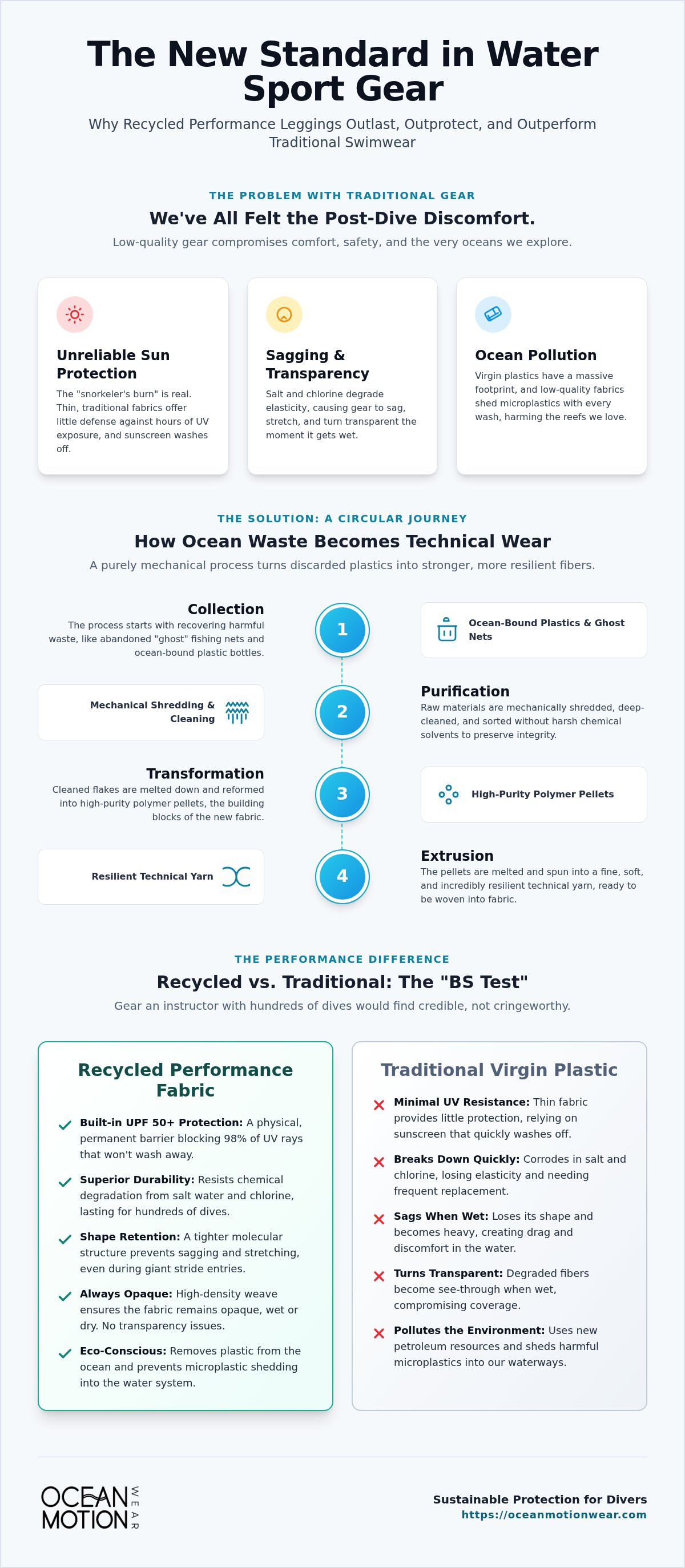
The transformation process is purely mechanical. It avoids the harsh chemical solvents often found in traditional textile manufacturing. This preserves the integrity of the polymer chains, resulting in a stronger fiber. Recycled performance swim leggings made this way aren't just "good enough." They are often more durable than their virgin counterparts. The technical journey includes several critical steps:
- Collection of abandoned "ghost" nets and ocean-bound plastic bottles.
- Mechanical shredding and deep cleaning of the raw materials.
- Melting the cleaned flakes into high-purity polymer pellets.
- Spinning these pellets into a fine, resilient technical yarn.
The resulting nylon has a tighter molecular structure that resists the stretching and sagging caused by salt water. We focus on a specific brushed finish to ensure the fabric remains soft. It needs to feel like a second skin, even when your legs are salt-chafed after a long day on the boat.
Why Ocean Lovers are Demanding Better Gear
We believe your gear should protect the reefs you love. Every time you wash low-quality polyester, it sheds microplastics into the water system. We combat this by using a high-density weave that keeps fibers locked in place. Our commitment to the ocean goes beyond the material itself. We utilize a made-to-order production model to eliminate the waste of unsold inventory. This ensures that every pair of leggings from our Whale Shark collection serves a specific purpose. It's about moving away from the disposable mindset of traditional swimwear and investing in gear that lasts for hundreds of dives.
Technical Benefits of High Performance Swim Leggings
I have spent countless hours on dive boats where the sun reflects off the deck with brutal intensity. Standard leggings often fail in these environments. They get heavy, they sag, or they let the sun right through the thin fabric. High-performance gear changes that experience entirely. It provides a level of security that allows you to focus on the reef rather than your equipment.
The Science of UPF 50+ in Water
Think of UPF 50+ as a high-quality car window tint for your legs. While sunscreen is essential for your face, it often washes off during a long surface interval or a two-hour drift dive. Recycled performance swim leggings provide a physical barrier that does not quit. The tight weave of these technical fibers is engineered to block 98 percent of harmful UV rays. This is critical for protecting the back of your knees. It is the most forgotten sunburn spot when you are snorkeling face-down for hours in a place like Tunnels on Kauai.
Durability is the final piece of this technical puzzle. Salt water and chlorine are incredibly corrosive to standard spandex. They eat away at the elasticity until your gear becomes transparent and loose. Technical recycled fibers are treated to resist this chemical degradation. This longevity means you are not replacing your kit every season. It is a more sustainable approach that respects both your wallet and the planet.
Compression and Fit in Extreme Conditions
Shore dives are the ultimate test for any gear. Dragging a tank and heavy weights over slippery rocks requires total freedom of movement. Our fabrics use a specialized four-way stretch that moves with your body rather than resisting it. It is about maintaining compression even after the fabric is saturated. Many traditional materials lose their "snap" once wet, but high-grade technical nylon keeps its shape. This prevents that dreaded heavy legging feeling when you finally climb back onto the boat.
Fit matters most when you are hitting the water. If you have ever performed a giant stride entry only to have your leggings slide down, you know the frustration. We designed our Eagle Ray collection with a specific stay-put waistband to solve this exact problem. The high-waisted cut provides security and comfort under a BCD or a heavy weight belt. It ensures your focus stays on your buoyancy and your surroundings. You can explore our full range of technical ocean apparel to find the right fit for your next adventure.
Recycled vs. Traditional Leggings: The BS Test
I used to believe that a legging was just a legging. In my early days of diving, I bought cheap pairs from "mall brands" thinking I was saving money for more air fills. I was wrong. After a week of diving in 82-degree water in Cozumel, those thin leggings were completely trashed. They had lost their shape, faded in the sun, and developed a permanent "salt-stiff" texture that no amount of fresh water could rinse away.
Traditional spandex is a magnet for salt crystals. Once those crystals dry, they act like tiny razor blades inside the fabric. This is why cheap gear loses its elasticity and starts to sag around the knees and waist after just a few outings. Recycled performance swim leggings use a much tighter technical weave that prevents salt from embedding itself so deeply. The sensory difference is immediate. While cheap leggings feel like wet tissue paper when saturated, high-performance recycled fabric feels like a supportive, protective second skin.
Transparency is the ultimate "BS Test" for water gear. We have all seen it. Someone climbs up the boat ladder and their leggings have gone completely see-through. This happens because the low-grade fibers have stretched past their breaking point and lost their density. Our technical nylon maintains its opacity even when fully saturated and under tension. It is the difference between feeling exposed and feeling secure as you move from the water to the deck.
Durability on the Dive Boat
Dive boats are not gentle environments. You are constantly sitting on rough non-skid decks or brushing against heavy plastic gear crates. Cheap fabric snags and pills the moment it touches a textured surface. High-performance recycled fibers are engineered for this kind of friction. They are built to withstand the physical demands of a working dive boat. These fibers also hold ink with incredible tenacity. The vibrant patterns in our Whale Shark collection won't fade into a dull, washed-out grey after three days in the tropical sun.
The Environmental ROI
Let's talk about the real cost of your gear. You can buy three pairs of "fast fashion" leggings that end up in a landfill by the end of the season, or you can invest in one pair of recycled performance swim leggings that lasts for years. To be truly sustainable, a product must be durable. There is a deep psychological benefit to wearing gear that aligns with your values while you are hovering over a reef. You aren't just protecting your skin from jellyfish stings and sun; you are supporting a circular system that keeps plastic out of the ocean.
Choosing the Right Leggings for Your Water Sport
I have used the same pair of leggings for a 90-minute shore dive at Blue Heron Bridge and a sunrise paddle session in Jupiter, Florida. While the gear is versatile, your priorities change depending on the sport. Recycled performance swim leggings are designed to adapt, but knowing what to look for helps you maximize their technical utility. I’ve found that a "good enough" fit on land usually becomes a "too loose" fit once you hit the salt water.
For divers, these leggings are about more than just style. They provide essential protection against hydroids and jellyfish stings in tropical waters. They also add a thin layer of thermal protection that can make the difference between ending a dive early or staying for that last macro photo. If you are a snorkeler, your focus is almost entirely on the surface. You need that 98 percent UV block to protect your calves while you are distracted by a hawksbill turtle.
Surfers and paddlers have different technical needs. You need a waistband that stays put during a high-energy pop-up or a long stretch to reach a buoy. A loose waistband is a liability when you are battling a shore break or duck-diving under a set. Layering is another hidden benefit. I always wear my leggings under a thicker wetsuit for cooler dives. They act like a lubricant, making it incredibly easy to slide into a sticky 5mm suit in a humid parking lot.
Fit Guide: From Boat Days to Shore Dives
Fit is the most important factor for performance. You want your leggings to feel like a second skin. If they are even slightly baggy on land, they will sag and create drag once they are saturated. I prefer a full-length cut for most activities. It provides total protection from the sun and prevents the "wetsuit rub" on your ankles. Check our performance fit guide for sizing tips to ensure you get the right compression for your body type.
Specific Features to Look For
Construction details separate professional gear from fashion pieces. We use flatlock stitching in all our designs. This creates a low-profile seam that won't chafe your skin during a three-hour paddle. A gusseted crotch is another essential feature. It allows for a full range of motion without putting stress on the seams. I personally love the Abalone collection for these exact reasons. It combines a sophisticated, artist-designed aesthetic with the rugged construction needed for a heavy week of diving. You can shop our entire range of technical leggings to find the perfect match for your next trip.
Ocean Motion Wear: Sustainable Protection for Divers
We didn't start this brand to just sell clothes. We started it because we were tired of gear that failed us during 60-minute dives in the Florida Keys or long shore treks at Tunnels on Kauai. We design for the human who dives. This means every seam and every pattern is tested by people who actually spend time under the surface. It is about readiness and well-being in a demanding environment.
Our commitment to recycled performance swim leggings is rooted in our own experiences. We wanted gear that protected us from the sun and sea while actively cleaning the environment we love. By using high-quality recycled fibers, we ensure that our impact is positive before you even hit the water. This is not just sportswear. It is purposeful craftsmanship designed to endure the salt and the sun.
The Whale Shark collection was born from a real encounter. I remember floating in the blue, watching that massive, starry pattern glide past with effortless grace. It was a humbling moment that stayed with me long after I climbed back onto the boat. We translated that feeling into hand-designed artwork. It isn't just a print. It is a tribute to the encounters that change the way we see the world.
Our made-to-order model is a deliberate choice for the planet. Traditional fashion creates massive amounts of waste through unsold inventory that often ends up in landfills. We produce only what is requested. This reduces textile waste and ensures that your gear is crafted with individual attention. It is a slower, more intentional process that supports a healthier ocean ecosystem.
Explore the Whale Shark and Eagle Ray Collections
Our marine life patterns are more than just aesthetic choices. They are conversation starters on the boat deck. Whether you are navigating the surge in Hawaii or enjoying a drift dive in Cozumel, these leggings perform with quiet authority. They provide the compression you need and the durability you expect from professional equipment. Browse the Whale Shark Collection to see how we blend art with technical performance.
Join a Community of Ocean Advocates
When you choose our gear, you are supporting a small, independent mission. We are not a massive corporation. We are a team of divers who believe that better gear leads to better ocean stewardship. We want our leggings to be a tool for your adventures and a statement of your values. Every pair represents a commitment to protecting the reefs we call home.
We also partner with those who share our vision. We offer wholesale opportunities for dive shops and eco-resorts that want to provide their guests with sustainable, high-performance options. It is about building a network of advocates who care about the blue planet. Learn about our wholesale partnerships to bring these collections to your local community.
Gear Up for Your Next Blue Adventure
We've moved past the era where eco-friendly meant sacrificing performance. High-quality technical gear is a necessity for anyone spending hours in the salt. It's a barrier that provides permanent UPF 50+ protection that won't wash off in the surf or fade after a week of diving. These fabrics have passed the "BS test" in real ocean conditions. They handle the friction of a boat deck and the pressure of a deep dive with ease.
Choosing gear that cleans the ocean while protecting your skin is a powerful choice. As a small, independent brand, we focus on durability and artist-designed aesthetics that reflect our deep respect for marine life. You can trust that our kit is built to last, reducing waste and keeping you secure in the water. We invite you to shop the full collection of recycled performance swim leggings and experience the technical difference on your next trip.
I'll see you in the water.
Frequently Asked Questions
Are recycled swim leggings as stretchy as regular ones?
Yes, they offer identical or superior stretch compared to virgin synthetics. We use a four-way stretch technical blend that moves with you during a shore dive or a surf pop-up. Unlike cheap spandex, these fibers don't lose their "snap" after being submerged in 80-degree water for an hour. They stay snug against your skin instead of sagging at the knees or waist.
How do I wash my recycled leggings to prevent microplastic shedding?
The best way to wash recycled performance swim leggings is to rinse them in cold, fresh water immediately after your dive. To prevent microplastic shedding, use a specialized wash bag like a Guppyfriend. Always air dry your gear in the shade. High heat from a dryer will damage the technical fibers and reduce the lifespan of your kit. It's a simple step for a healthier ocean.
Can I wear these leggings in a chlorinated pool?
You can absolutely wear these in a chlorinated pool. The technical nylon is engineered to be chlorine-resistant, which is essential if you are doing pool laps or practicing buoyancy skills. Just remember to rinse them thoroughly afterward. Chlorine is a harsh chemical that can eventually eat away at any fabric if it is left to dry into the fibers for long periods.
Do swim leggings provide enough warmth for cold water diving?
These leggings are designed for tropical waters or as a base layer. On their own, they won't provide the thermal insulation of a 5mm neoprene suit in 65-degree water. However, I always wear them in 80-degree water to prevent stings and sun damage. They also make it much easier to slide into a thick wetsuit when you are doing multiple boat dives in humid conditions.
Are these leggings squat-proof and non-transparent when wet?
Yes, our high-density weave ensures they remain squat-proof and opaque even when fully saturated. We know the frustration of gear that turns transparent the moment you climb a boat ladder. We have tested these in various light conditions to ensure you stay covered. The fabric maintains its integrity and density regardless of how much it stretches during your underwater movements or shore entries.
How long do recycled performance swim leggings typically last?
A high-quality pair of recycled performance swim leggings can last several seasons with proper care. I have pairs that have survived over 100 dives and still look new. They typically outlast traditional "mall brand" leggings by two or three times because the fibers are more resistant to salt degradation. Investing in better material means you are keeping gear out of the landfill for longer while maintaining protection.
What is the difference between swim leggings and regular gym leggings?
Regular gym leggings are designed to absorb sweat, which means they become heavy and waterlogged in the ocean. Swim leggings are made from hydrophobic materials that shed water and dry rapidly. They also feature built-in UPF 50+ protection, which is rarely found in standard gym wear. If you wear gym leggings for a dive, you'll likely deal with sagging, transparency, and extreme chafing.
Will the ocean-inspired prints fade in the sun?
Our ocean-inspired prints are designed to stay vibrant even after long days in the tropical sun. We use high-tenacity inks that bond deeply with the technical fibers. While any fabric will eventually show wear after years of use, these won't turn into a dull, washed-out grey after one season. I’ve taken my Whale Shark leggings through dozens of sun-drenched surface intervals without seeing any noticeable fading.
