


I remember surfacing at a challenging reef and feeling that familiar, annoying tug. My headband had slipped again, leaving my hair to tangle in my mask straps during a 45 minute dive. It’s a common frustration for anyone who spends more time in the water than on land. We've all dealt with the sting of salt water in our eyes and the lingering burn on our foreheads after a long day on the water.
You probably agree that most gear marketed for the surf just doesn't hold up. They either slide off during a duck dive or lose their elasticity after one week in the salt. It makes it hard to focus on the swell when you're constantly reaching up to adjust your gear. At Ocean Motion Wear, we've spent years testing fabrics in dynamic, warm ocean conditions to figure out why a non slip headband actually works when the pressure is on.
We want to show you that a secure fit doesn't need sticky adhesives to stay put. We'll explore the science of hydrodynamic grip and how fabric tension survives the waves. You'll learn how to choose a headband that offers UPF 50+ protection and stays secure through a two-tank dive. At Ocean Motion Wear, we are moving past the trial and error phase of gear to find pieces that respect the power of the ocean.
Key Takeaways
- Learn how saltwater acts as a lubricant and why a non slip headband relies on surface area rather than adhesives to stay put.
- Identify the best performance materials, such as recycled polyester blends, that provide four-way stretch without losing their shape in the waves.
- Discover why tapered designs are more effective at preventing fabric bunching at the base of the neck during high-intensity movement.
- Master the "sandwich" technique by layering your headband under a mask strap to keep hair secure during long dives.
- Support ocean conservation by choosing made-to-order gear crafted from high-quality recycled fabrics.
The Physics of Why Headbands Slip in the Ocean
I have spent years watching divers on the Kona coast lose their favorite bands to the current. It usually happens during a giant stride entry or a quick descent. You see a flash of color drift away into the blue, and that's the end of it. Most of those lost accessories were never designed for the unique pressures of the Pacific. We believe a headband must stay secure without needing a constant "death grip" on your temples that leads to a post-dive headache.
The ocean is a high-energy environment that exposes every flaw in your gear's construction. When you're moving through a swell or descending to a reef, water isn't just sitting there. It's actively pushing against you. If your gear isn't built to handle that force, it's going to move. Finding a non slip headband that actually stays put requires understanding how water interacts with fabric and hair.
The Role of Saltwater Lubrication
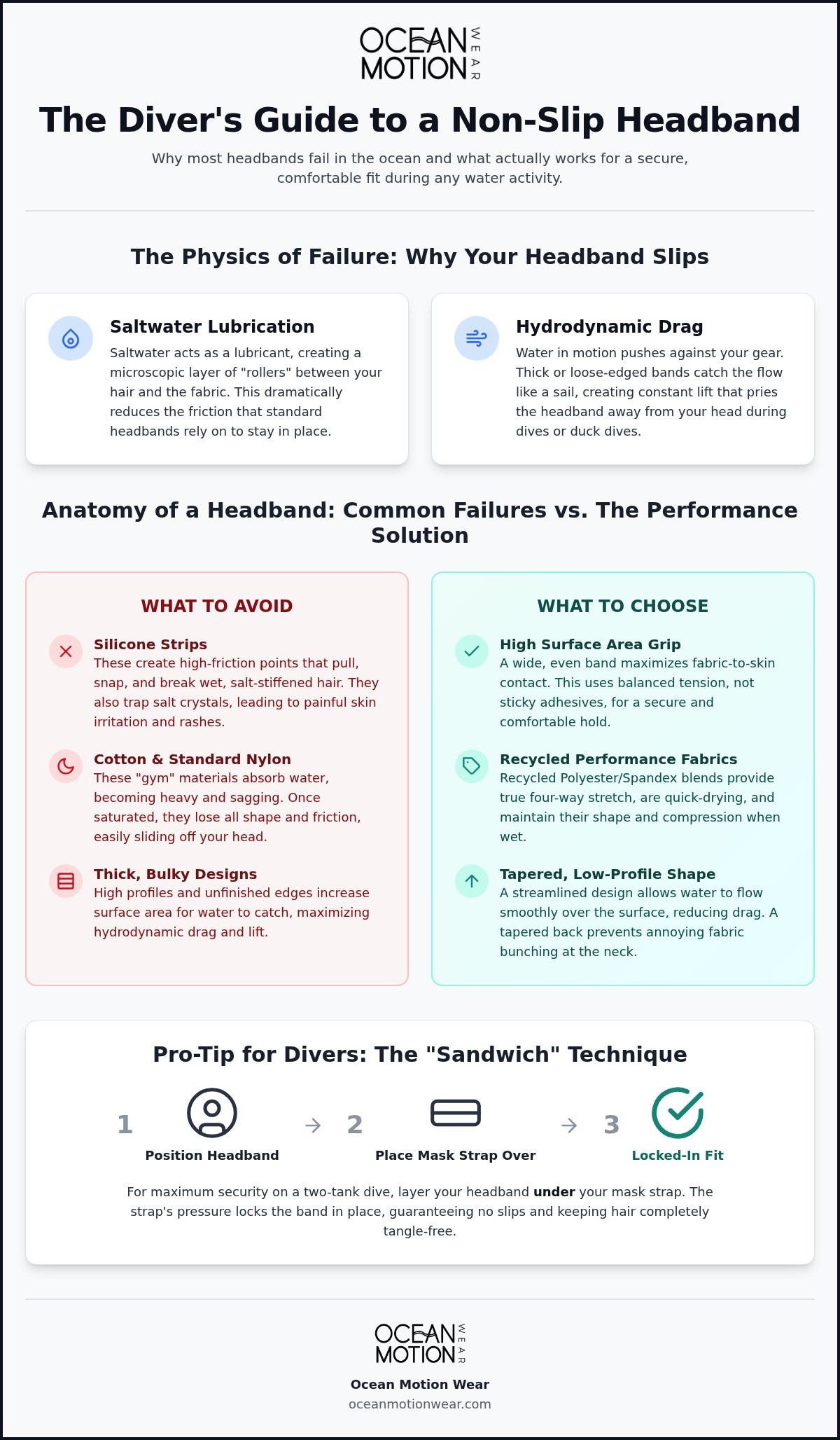
Saltwater acts as a lubricant that makes standard cotton or nylon bands slide easily. During a 45 minute dive, salt crystals begin to sit between the hair shaft and the fabric. This creates a microscopic layer of "rollers" that significantly reduces friction. While your hair might feel coarse and "salty" to the touch, it's actually much slicker than dry hair when submerged.
Standard "gym" headbands fail after the first splash because they rely on dry friction. They're designed to absorb sweat, but once they're saturated with 78 degree ocean water, they become heavy and loose. The weight of the water-logged fabric works with the salt lubrication to pull the band right off the back of your head. You need a material that maintains its integrity when wet rather than becoming a soggy liability.
Drag and Water Pressure Dynamics
Hydrodynamic drag is the force that pulls gear away from the body in motion. Think about the sensation of water pushing against your mask or your regulator during a descent. If a band is too thick or has loose, unfinished edges, the water catches it like a sail. This pressure is constant, and it's always looking for a way to get underneath the fabric.
I like to compare fabric density to a car's window tint. Just as a high-quality tint is perfectly bonded to the glass to prevent peeling, a non slip headband needs a low profile to stay bonded to your head. If the profile is too high, the water creates enough lift to break the seal. We focus on streamlined designs that allow water to flow over the surface rather than getting trapped underneath the edges.
- Low-profile edges reduce the surface area available for water to catch.
- High-density weaves prevent the fabric from stretching out when wet.
- Compression levels must be balanced to provide security without discomfort.
The Science of Grip: Materials That Defy the Waves
I prefer performance fabrics that use surface area instead of sticky strips to keep things in place. When you're out in the midday sun in Kona, your scalp needs more than just a tight elastic band. It needs UPF 50+ protection that won't wash away or lose its effectiveness in the surf. We focus on materials that feel like a second skin, providing a secure fit that lasts through the heaviest sets and the longest surface intervals.
A high-quality non slip headband relies on the physics of tension and surface contact. We use recycled polyester and spandex blends because they offer a true four-way stretch. This means the fabric moves with you, whether you're duck diving or checking your gauges at depth. These materials are also incredibly quick-drying, so they don't get heavy or sag when water-logged, which is a common failure point for cheaper alternatives.
Why We Avoid Silicone Strips
Many brands claim that silicone strips are the only way to prevent slipping. In my experience, silicone is a disaster for fragile, wet hair. It creates a high-friction point that pulls and snaps strands when you try to remove the band after a dive. It's especially brutal if you have salt-stiffened hair that's already prone to breakage. I've seen too many divers struggle with "headband hair" where the silicone has literally ripped out patches of hair near the temples.
Salt buildup is another issue that most manufacturers ignore. When you're in the water for a long time, salt crystals get trapped under those silicone strips. This causes significant skin irritation and can lead to a painful, itchy rash on your forehead. I've found that fabric-to-skin friction is far superior for long-term comfort and health. It allows the skin to breathe while maintaining a reliable grip through the natural texture of the knit.
The Power of Recycled Performance Fabrics
We've proven that recycled materials offer the same, if not better, durability than virgin nylon. These fabrics are engineered to withstand the harsh UV rays and high salinity of the Pacific. They don't lose their elasticity after a few sessions in the surf. Instead, they retain their shape and provide consistent compression that doesn't feel like a tight rubber band around your skull. This balance of tension and softness is what keeps the band from migrating during high-intensity movement.
Our Whale Shark collection is a perfect example of how performance and art can intersect. Each piece is designed to be functional art that protects you from the elements while looking beautiful. If you are looking for gear that respects the ocean as much as you do, you can explore our full range of sustainable swimwear to find your next favorite piece. We believe in gear that empowers you to focus on the blue without worrying about your equipment.
Tapered vs. Wide: Choosing the Right Shape for Your Sport
I have found that the shape of your gear is just as important as the fabric it's made from. Every ocean lover has a different head shape and hair volume to manage, so a one-size-fits-all approach usually fails by the second wave. Choosing a non slip headband is about matching the geometry of the band to the specific movement of your sport. We believe that understanding how fabric sits against your anatomy is the key to a frustration-free day in the surf.
Most uniform-width bands on the market ignore the way the human neck moves. When you're active, your head isn't static. You're looking up at the horizon, checking your surroundings, or ducking under a swell. If the shape of the band doesn't account for these shifts, it's going to migrate. The choice between a tapered or a wide design should be based on your specific activity and how much hair you're trying to keep under control.
The Benefits of a Tapered Design
I have spent many long days on the boat watching wide headbands fail because of a simple physics problem. When you look up at the surface or tilt your head back to check your tank pressure, a wide band at the base of your skull bunches up. This creates a "pop off" effect where the excess fabric pushes the band forward until it slides off. A tapered design reduces this bulk at the base of the skull where most movement occurs.
It is my personal choice for diving because it fits seamlessly under a wetsuit hood. There is no extra fabric to chafe against your neck or create a gap for cold water to enter. By narrowing the fabric at the nape, you ensure the tension remains focused on the forehead and the sides of the head. This keeps the fit secure without requiring you to constantly pull the back of the band down during a 45 minute dive.
Wide Bands for Scalp Protection
While I prefer a tapered fit for high-movement diving, wide bands serve a vital purpose for surface sports and sun safety. For bald men or those with thinning hair, a wide front is a critical tool for preventing sunburn on the most vulnerable parts of the forehead and scalp. Think of it like a specialized shield that stays in place while you paddle or swim. A wider front also provides more surface area for the fabric to "grip" the skin, which can be helpful if you're managing a lot of hair volume.
Our Abalone collection offers versatile coverage that works well for these scenarios. These bands cover more real estate on the head, ensuring that you don't return from a session with a bright red line across your brow. Whether you're navigating a winter swell or enjoying a calm morning paddle, the right width ensures your focus stays on the water. We believe gear should adapt to the person, providing both functional art and reliable protection from the elements.
Pro Tips for a Secure Fit Under a Scuba Mask or Surf Cap
I always place my headband slightly lower on the forehead than I would at the gym. When you're on a yoga mat, you want the fabric away from your brow to catch sweat. In the ocean, a non slip headband needs to sit closer to your eyebrows to prevent the water from getting a "grip" on the front edge. This lower placement ensures that when you hit the water, the pressure pushes the band against your head rather than lifting it up and off.
Positioning the band under your mask strap creates what I call a "sandwich" effect for maximum security. By layering the fabric between your scalp and the silicone of your mask or surf cap, you lock it into place. We also recommend wetting your hair with fresh water before putting the band on. This improves the initial seal and prevents your hair from acting like a dry, slippery cushion that allows the band to slide during your entry.
Integration With Scuba Gear
The most important rule for divers is to avoid breaking the seal of your mask with the headband edge. If the fabric overlaps with the silicone skirt of your mask, you'll spend your entire dive clearing water from your eyes. I use a "tuck and roll" method for my long hair at the reef at Tunnels on Kauai’s North Shore. I tuck the loose strands under the mask strap and roll the edge of the headband just slightly to ensure it stays a finger-width away from my mask.
This technique is essential when navigating the surge or looking up to find your dive buddy. I've learned the hard way that a stray piece of fabric can ruin a 45 minute dive by causing a constant, slow leak. Always do a quick mirror check or ask your buddy to ensure no fabric is caught under the mask skirt before you descend. We also recommend checking the fit during your surface interval to ensure no salt has built up to create those "rollers" that encourage slipping.
Layering for Sun and Wind
When you're moving between the water and a fast boat ride, your gear has to work double duty. I often wear my headband with a sun protective top to ensure I have total coverage from the 6am boat ride until we head back to the pier. If you're on a boat moving at high speeds, the wind can be just as aggressive as the waves. I find that wearing the band slightly wider increases the surface contact and prevents the wind from catching the edges.
Quick-dry fabrics are vital here because they prevent you from getting chilled as the wind hits your wet gear. If your band stays soggy, it will eventually stretch out and lose its grip. Our gear is designed to transition seamlessly from the deep to the deck without losing its shape or security. If you're ready to upgrade your ocean kit, you can shop our collection of waterproof headbands to find a piece that stands up to the elements. We believe that when your gear fits correctly, you can stop worrying about your hair and start focusing on the blue.
Ocean-Inspired Gear Built for the Deep
I started Ocean Motion Wear because I was tired of gear that didn't respect the ocean. For years, I watched mass-market accessories fail during the most critical moments of a dive. Most big-box brands treat a non slip headband as a disposable item you might lose after a few sessions in the surf. I disagree with that mindset entirely. We believe that if you build a non slip headband with integrity, it stays with you rather than becoming another piece of "ghost gear" on the reef.
Our made-to-order process is a deliberate choice to protect the places we love. We only create what is actually needed, which eliminates the waste common in traditional manufacturing. Every print we offer, from the Whale Shark to the Eagle Ray, is inspired by real encounters in 78 degree Kona water. I want you to feel confident and focused on the marine life around you, not on whether your hair is about to tangle in your regulator.
Design That Respects the Environment
We use recycled materials for our production to ensure we aren't adding new plastics to the ecosystem. Small-batch manufacturing is our way of fighting the overproduction that plagues the garment industry. When you choose gear that is built to last, you're making a choice to keep the ocean cleaner for the next generation of divers. I've tested these fabrics through winter swells in Hawaii to ensure they don't break down after a few salt-soaked weeks. You can explore our full collection to find the right fit for your next adventure in the blue.
A Boutique Approach to Performance
As a boutique brand, we can focus on the details that larger companies often overlook. This includes inclusive sizing and personal service that ensures you get exactly what you need for your head shape. Our premium fabrics are selected for their durability over multiple seasons, not just a single trip. We aren't interested in selling you a new band every month; we want to sell you the one that becomes a permanent part of your dive kit.
I've found that the longevity of our materials actually saves money and reduces waste over time. For businesses that share our values, we encourage you to check our wholesale options for your dive shop. We love partnering with shops that prioritize quality and environmental stewardship. When we work together, we can ensure every diver is equipped with gear that performs as beautifully as the ocean itself.
Gear Up for Your Next Great Descent
We've explored how the right materials and geometry prevent the Pacific from claiming your favorite accessories. You now understand that a true non slip headband relies on surface area and four-way stretch rather than hair-pulling silicone strips. By matching a tapered design to your head shape and using the "sandwich" method with your mask strap, you can finally stop fighting your hair and start focusing on the reef.
Every design we offer is rigorously tested in the winter swells of Hawaii and the cold currents of Southern California. We use recycled, ocean-friendly materials that provide built-in UPF 50+ protection for those long surface intervals on the boat. It's gear built for people who understand that high-level performance and environmental mindfulness must go hand in hand. I've spent years refining these details so you don't have to learn the hard way through lost gear.
I invite you to explore our collection of non-slip, ocean-inspired headbands and find a piece that stays secure through every dive. We're here to help you feel both capable and protected in the water. Let's get back to the blue with gear that respects the power of the ocean.
Frequently Asked Questions
Can I wear a non slip headband while scuba diving?
Yes, it is a staple for many of us in the diving community. I use mine to keep hair from tangling in mask straps during a 45 minute dive at the reef at Tunnels. Just ensure the fabric doesn't sit under your mask skirt or you'll deal with a slow leak. A non slip headband is a tool for focus when you're checking your gauges at depth.
Will a waterproof headband protect my scalp from sunburn?
Yes, our headbands provide built-in UPF 50+ protection which acts like a permanent window tint for your skin. This is vital for long surface intervals on a boat in Kona where the sun is relentless. It protects the part in your hair and your forehead from painful burns. Unlike sunscreen, it won't wash off or sting your eyes when you hit the 78 degree water.
How do I wash a headband after it has been in saltwater?
Rinse it in fresh water immediately after your session to remove salt crystals. I usually take mine into the post-dive shower and give it a quick rinse with mild soap. Avoid harsh detergents that can break down the recycled fibers or the spandex. Air dry it in the shade rather than direct sunlight to preserve the vibrant prints and the elasticity of the fabric over multiple seasons.
What is the best headband for very thick hair in the water?
I recommend our wide-front designs for those of us with significant hair volume. The extra surface area provides a better "grip" and helps compress the hair so it doesn't float into your field of vision. Tapered backs are still useful here to prevent the band from bunching at the nape of your neck. It ensures the tension stays even across your head throughout a high-intensity session.
Is it better to put a headband on wet or dry hair for diving?
Wetting your hair with fresh water before putting the band on creates a much more secure seal. Dry hair is surprisingly slippery and can act as a cushion that allows the fabric to slide. When your hair is wet, the non slip headband can bond directly to the surface of your head. This technique is a game changer for giant stride entries where gear is most likely to shift.
Can men wear these headbands for sun protection?
Absolutely, and many bald or thinning divers find them essential for scalp safety. A wide-front band protects the top of the head where hats usually fail in the water. We designed our prints to be inclusive and functional for everyone who spends time in the surf. It is a much more reliable solution than trying to reapply sunscreen while you're bobbing in a swell during a winter swell.
Do these headbands cause headaches during long surf sessions?
No, because they rely on surface area and four-way stretch rather than sheer elastic pressure. Cheap bands often use a "death grip" to stay on, which leads to a pounding headache after an hour. Our recycled polyester blends provide a gentle but firm compression that distributes the tension evenly. You should feel secure and protected without feeling like your temples are in a vice during your session.
What makes a headband "waterproof" versus just water-resistant?
In the context of our gear, "waterproof" means the fabric doesn't become heavy or lose its shape when submerged. Many "water-resistant" gym bands absorb water like a sponge, becoming a soggy liability that slides off. Our materials are quick-drying and maintain their tension even in 78 degree water. We build gear that respects the ocean's power rather than being defeated by the first splash or a heavy current.
