


A vivid ocean print matters. So does what happens when you stretch, swim, and move through a long day. Abalone collection performance leggings use four-way stretch and a fabric blend of 88% polyester and 12% spandex. The printed design is made to resist fading from washing, sun, saltwater, chlorine, and sunscreen.
You’re right to look beyond appearance when choosing Abalone collection performance leggings for water and sun. Wet opacity, breathability, and drying time can affect how comfortable and covered you feel, while fit and care influence how often you reach for them.
This guide explains fabric stretch, color and coverage in and out of the water, and basic care. You’ll get a practical sense of how the leggings are designed to move and feel, so you can decide whether they suit your time by the ocean.
Key Takeaways
- Learn how four-way stretch helps leggings move with you and recover their shape.
- See what the 88% polyester and 12% spandex blend means for fit and feel.
- Understand what to consider when assessing coverage in and out of the water.
- Explore how fabric construction can affect breathability and drying time.
- Find out how to care for the printed fabric and help preserve its color.
Four-way stretch
Four-way stretch lets fabric move across and along the body, giving your legs room to bend and extend. The Abalone collection performance leggings are designed with four-way stretch and recovery, which means the fabric is designed to return to shape after stretching.
Consider a simple finning motion: your knee bends and straightens while your hip rotates. Stretch in more than one direction supports that changing movement. Fabric that stretches only one way may feel less adaptable.
Stretch matters on shore, too. You might squat to adjust a fin strap, step over a boat edge, or reach for a mask. Each movement asks the fabric to flex differently.
Recovery is the other half of the feature. Fabric needs to flex, then settle back into shape. This can help the leggings retain their intended shape through repeated movement, but it doesn’t replace choosing the right size.
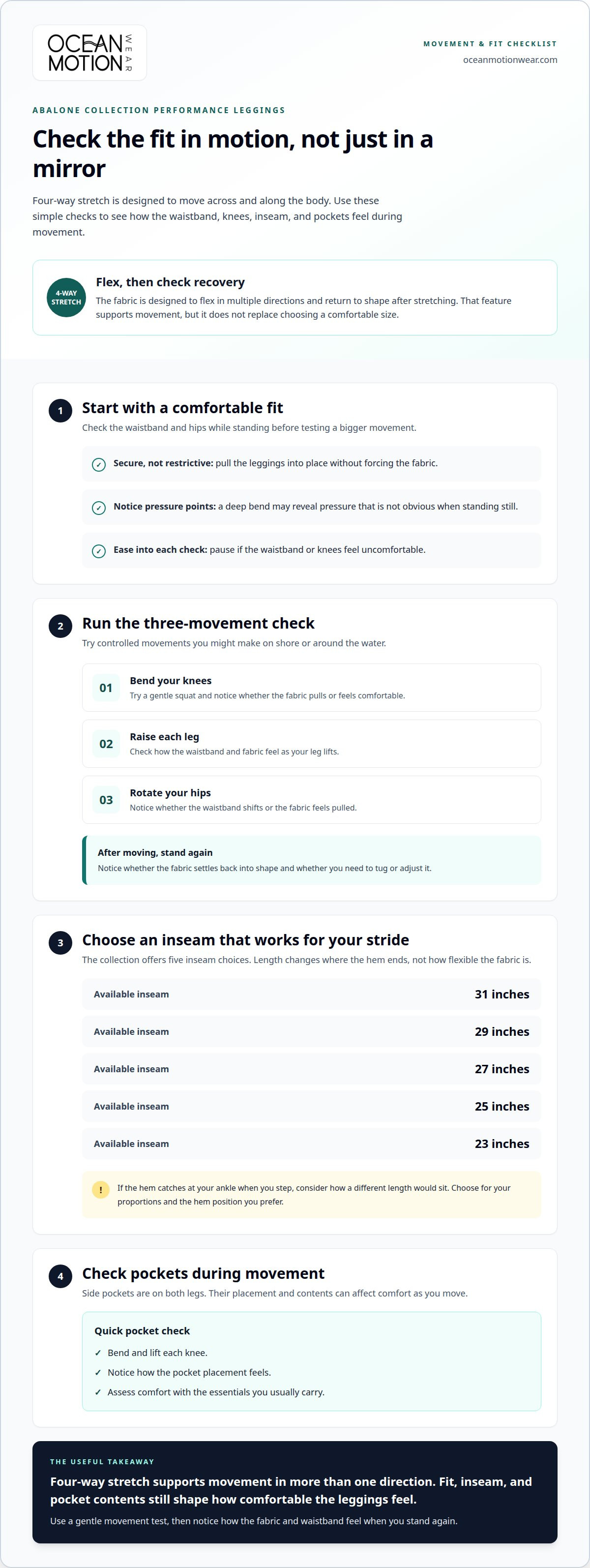
Start with the waistband and hips. Pull the leggings into place without forcing the fabric. They should feel secure, not restrictive, while you stand. A deep bend can reveal pressure that standing doesn’t.
Try three movements before heading out: bend your knees, raise each leg, and rotate your hips. Notice whether the waistband shifts or the fabric pulls. These checks help you assess your range of motion.
A high step when entering the water can draw fabric across your thighs. On a beach walk, a long stride stretches your knees and hips in sequence. Both examples show why testing movement matters more than judging a mirror pose.
Stretch doesn't determine inseam length. The Abalone collection performance leggings offer inseam choices of 31, 29, 27, 25, or 23 inches. Choose the length that suits your proportions and how you want the hem to sit.
A shorter inseam changes where the hem ends, not how flexible the fabric is. If the hem catches at your ankle as you step, a different length may feel more practical.
The leggings also have side pockets on both legs. Check their placement as you bend and lift each knee. Pocket contents can move with your body, so assess comfort with the essentials you usually carry.
Use the Abalone collection as the reference point for these design details. The collection's printed leggings combine stretch and recovery with a distinct ocean-inspired look from Ocean Motion Wear.
Keep your movement test gentle. Pulling hard on a small section won’t show how the whole garment fits. Instead, try a controlled squat or lunge, then check how the waistband and knees feel.
Stretch can feel different across body shapes. Two people wearing the same size may experience different tension at the hips, thighs, or waist. A few deliberate movements provide more useful feedback than standing still.
After moving, look for areas that remain pulled tight and notice whether the fabric settles back when you stand. These observations help you judge comfort for swimming, paddling, or moving around the shore.
Four-way stretch supports movement in multiple directions, but fit still depends on length and proportion. Consider your usual activities, try familiar movements, and choose an inseam that works for your stride.
Different body types experience comfort and range of motion differently, so pay attention to how the fabric responds across a full movement rather than judging it from a still stance. The leggings use four-way stretch and recovery for shape retention in and out of the water. Treat that as a design feature, not a reason to force a movement or choose a tighter fit. Ease into bending and stepping, and pause if the waistband or knees feel uncomfortable.
After activity, notice how the leggings feel when you stand again. Fit, inseam, and pocket contents can all affect comfort, so consider them alongside stretch. A useful test is one you can repeat without tugging at the waistband or adjusting the fabric. That gives you a practical sense of how the garment behaves during everyday movement, on shore and in the water.
Material and color
Color is personal, but it helps to choose a print with your plans in mind. The Abstract Ripple Abalone and Mother of pearl design brings an ocean-inspired motif to an activewear look. Consider whether you want the print to stand out or sit quietly alongside other pieces.
For a coordinated outfit, choose one color from the print as your anchor. Pairing patterned leggings with a plain charcoal top, for example, keeps the visual focus clear. A neutral layer can also make the design easy to wear beyond the shoreline.
For a more expressive look, use a second color as an accent. A simple bag or cover-up in a complementary shade can bring the outfit together without adding another competing pattern. Aim for balance, not a perfect color match.
Consider where you’ll wear the leggings. A bold print can feel at home at the beach, while a boat ride may call for a simpler layer over it. Your plans can help you decide whether to keep the design visible throughout the day.
The words “Abalone” and “Mother of pearl” evoke shell surfaces and ocean forms. Treat them as design inspiration, rather than expecting every screen or room to show the same impression. Your preference matters more than matching an imagined shade.
Look at the garment as a complete design. Notice how the print reads from waist to ankle instead of judging a small section alone. The full-length silhouette gives the artwork a continuous canvas, so the overall pattern may look different from a close-up.
Try a quick styling exercise before packing. Set the leggings beside two tops you already wear, perhaps one in a solid dark shade and one in a lighter neutral. See which combination feels right for a swim day or a casual stop afterward.
Think about what you already own. If your swim layers are mostly solid colors, printed leggings can add visual variety. If your usual pieces already have bold patterns, a quieter companion layer may make the outfit feel less busy.
Color can also affect how often a piece fits your routine. A print you enjoy wearing with familiar layers is easier to bring along than one reserved for a single outfit. Imagine it with a swim top, then with a relaxed beach layer.
For a practical decision, picture three settings where you’d wear the leggings: a pool visit, a beach walk, or a boat day. Pick the setting that matters most, then consider whether the print suits the scene and the layers you’ll bring.
Finally, separate design preference from performance questions. A shell-inspired print can express your connection to the ocean, but it doesn’t answer questions about coverage or comfort. Assess each on its own, then decide whether the design feels like you.
Opacity when wet or dry
Opacity describes how much shows through the fabric. A dry fitting gives only part of the picture: water can change how fabric rests against your body, and stretching can alter its appearance. Assess dry, wet, and moving conditions separately.
Start with the leggings dry and fitted as you’d wear them. Stand in even light, then check the front, seat, and knees. A full-length mirror helps you see the garment from different angles. Don’t judge coverage from a folded piece of fabric.
Next, try positions that stretch the fabric. Bend your knees, sit, and raise each leg. Watch the areas across your hips and thighs. A garment may look opaque while standing, then appear different when stretched over a bent knee.
Lighting matters. Compare the same area near a bright window and in a shaded spot. Direct sunlight can reveal details that softer indoor light hides. Keep the setting consistent when comparing dry and wet fabric.
For a wet check, dampen the leggings evenly with clean water. Look at the same areas from the same angles, and compare with the dry view instead of relying on memory. A wet patch beside dry fabric may look different from a fully wet garment.
Notice how the fabric rests against your skin when wet. If it clings closely over the seat or thighs, the outline beneath may become more visible. That doesn’t automatically mean the fabric is see-through, but it does show how fit and fabric contact affect appearance.
Underlayers can change what you see. Try the leggings with the underwear you’d actually wear swimming. A dark layer beneath a light part of a print may look different from a close skin tone. Check the front and back while standing and bending.
Look at the print, too. The Abstract Ripple Abalone and Mother of pearl design has multiple visual elements. A pattern may make subtle changes harder to notice than a solid shade, but it can’t establish whether fabric remains opaque when wet.
Use a simple comparison routine: check the leggings dry while standing, repeat while moving, then check them wet in the same light. Keep the fit and underlayer consistent. Changing one condition at a time makes the result easier to interpret.
Opacity isn’t a single yes-or-no impression. It can vary with body area, garment tension, lighting, and moisture. For example, the knees may look unchanged while stretched fabric across the hips appears different. Assess each area under the conditions you expect.
Before a swim, base your decision on the wet, moving view, not just a dry mirror check. If you plan to snorkel in the leggings, include a raised-knee position like the one you’d use stepping into the water. This gives you a more useful picture of coverage in motion.
Quick-drying, breathable fabric
Quick-drying and breathable describe different qualities. Drying is water leaving the garment; breathability concerns heat and moisture moving away from your skin. A beach walk after swimming can put both to the test as damp fabric meets warm skin and moving air.
There’s no single drying time for every outing. Humidity, shade, wind, and how wet the leggings are all affect evaporation. A breezy shoreline and a still changing room create different conditions. Consider the setting you expect, rather than an imagined perfect day.
Breathability becomes noticeable during activity. Finning, walking uphill from the shore, or carrying beach gear generates warmth. If fabric holds that heat, dampness may feel less comfortable. Pay attention to how the leggings feel while moving, not only while standing.
A useful test is a short walk after swimming. Notice whether the fabric feels clammy at the waistband, behind the knees, or across the thighs. Those areas stay close to your skin as you move. Then pause in the shade and notice whether airflow changes how the fabric feels.
To understand drying, consider the surroundings. Wind replaces moist air beside the fabric with drier air. High humidity reduces that difference, so evaporation may feel slower. Shade can feel cooler, while direct sun warms the garment.
Compare conditions instead of guessing. After swimming, notice how the leggings feel in a sheltered spot, then again where air moves freely. Keep your activity and exposure similar so airflow is the main difference you’re assessing.
Fabric thickness and fit can also affect comfort. An area that fits closely may feel damp against your skin longer than fabric with more airflow around it. For example, compare the waistband with the lower leg during the same walk.
Quick-drying doesn’t mean instantly dry. It describes a fabric quality, not a fixed duration. A wet garment in humid, still air may take longer to feel dry than one exposed to moving air. Plan for changing conditions on boat days.
Breathability isn’t the same as warmth, either. A damp garment can feel cool after you leave the water, especially in wind. If you’ll sit on a shaded deck, bring a dry layer rather than expecting breathable fabric to keep you warm.
For a practical check, notice three things during one outing:
- How damp the fabric feels while you’re active.
- Whether airflow changes comfort during a pause.
- How the garment feels in shade versus sun.
Keep your observations tied to your usual routine. A short snorkel followed by a sunny beach stay differs from a long boat ride in humid air. The same leggings can feel different as the conditions change.
Choose based on the day you actually have planned. If you’ll move between water, sun, and a breezy deck, consider how each transition feels. That gives you a more useful assessment than expecting one fabric to dry at the same pace everywhere.
Ocean Motion Wear: swim leggings
Ocean Motion Wear offers swim leggings for time in and around the water. Its products are made from recycled materials and feature built-in UPF 50+ protection, a useful consideration for long stretches outdoors. Choose swim leggings when you want coverage for swimming, snorkeling, or beach activities, and weigh fit, print, and care alongside fabric performance.
The details covered here can help you decide what matters most: stretch for movement, a print that suits your style, and a practical care routine after saltwater or pool use. If swim leggings fit your plans, explore the options with those priorities in mind. For help with your questions, contact Ocean Motion Wear.
Make your next ocean day your guide
Let the details that matter to your routine guide your choice. Think about where you’ll wear the leggings, how freely you want to move, and what feels comfortable after leaving the water. A calm shoreline swim and a full day outdoors can call for different priorities.
If Abalone collection performance leggings are on your shortlist, use what you’ve learned to decide whether their design suits your plans. Consider your movement and comfort, not just how a print looks on screen. Choose gear that supports the day you want to have.
Explore Ocean Motion Wear’s collection and find pieces that fit your next adventure. Head toward the water feeling prepared, comfortable, and ready to enjoy the moment.
Frequently Asked Questions
What is the Abalone Collection performance leggings line?
It’s an ocean-inspired range of printed swim leggings designed for movement in and around the water. The Abalone Restoration Leggings feature an abstract shell-themed design, with practical details for active days. The purchase also supports abalone restoration: 10% of profits are donated to the restoration effort. Consider the leggings for swimming, snorkeling, or beach wear when you want coverage with an ocean-centered print.
What styles, colors, and sizes are available in the Abalone Collection?
The Abstract Ripple Abalone and Mother of pearl print is shown in a full-length style. The model wears size Small, and inseam choices are 31, 29, 27, 25, or 23 inches.
